Hotel GST Rate in 2026: A Business Guide to GST Slabs, Hotel Bills, and ITC

Hotel accommodation is a recurring expense in corporate travel budgets. Whether employees travel for client meetings, project assignments, conferences or business events, hotel bookings contribute to an organisation's overall travel expenditure.
However, understanding the hotel GST rate involves more than checking the tax percentage added to a room bill. Businesses must also consider the applicable room tariff slab, invoice requirements, input tax credit (ITC) eligibility and the way accommodation is booked.
With India's revised GST rates effective from 22 September 2025, the tax treatment of hotel accommodation has changed. For finance and procurement teams, understanding these provisions is important for managing travel expenses, maintaining GST compliance and identifying eligible tax credits.
Here is what businesses need to know about GST on hotel bookings in 2026.
1. What is the hotel GST rate in India in 2026?
Hotel accommodation in India attracts GST at two rates, depending on the value of supply per unit of accommodation per day.
Following the recommendations of the 56th GST Council meeting, the GST rate for hotel rooms costing up to ₹7,500 per unit per day was reduced from 12% to 5%, effective 22 September 2025. Rooms costing more than ₹7,500 per unit per day continue to attract 18% GST.
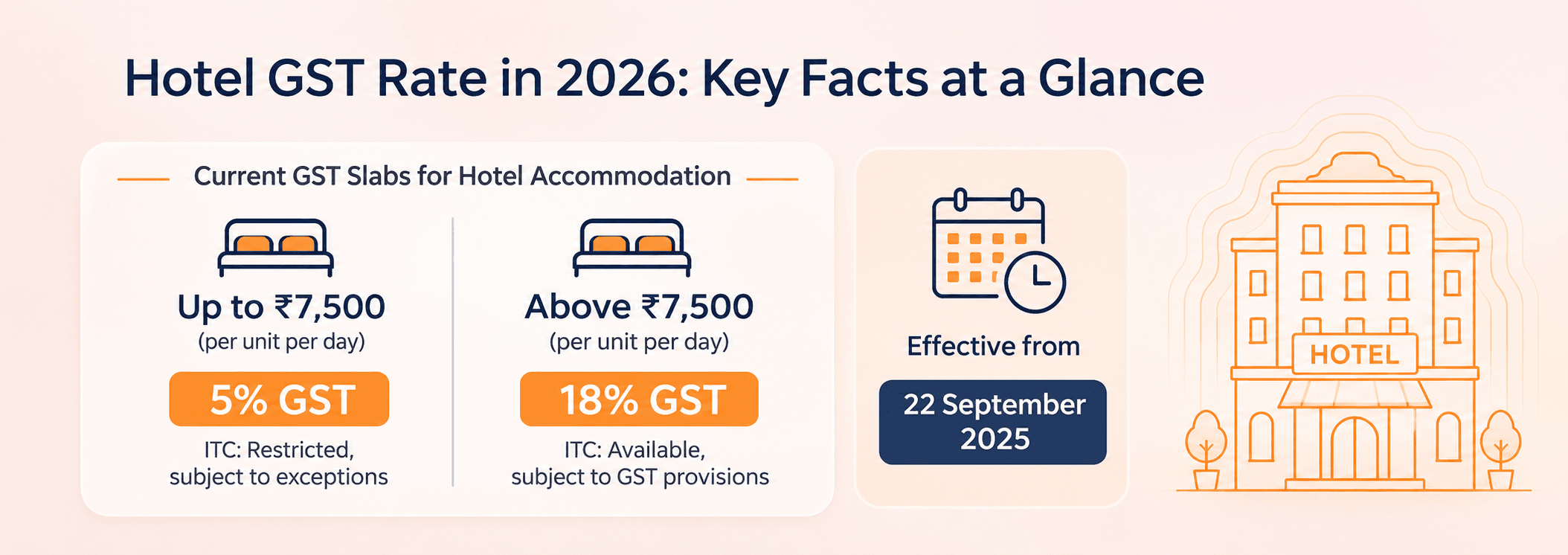
An important distinction: The ₹7,500 threshold is based on the value of supply of the accommodation unit per day, not the hotel's star classification. A five-star hotel can charge 5% GST if the applicable room value falls within the threshold.
The 5% rate is mandatory for accommodation valued at ₹7,500 or less. Hotels cannot choose to charge 18% GST with full ITC on these rooms.
For businesses, this distinction matters when comparing accommodation costs across properties and evaluating the tax component of travel expenditure.
Source: Ministry of Finance – FAQs on the 56th GST Council decisions.
2. How does GST on hotel booking work through an OTA versus direct booking?
Businesses can book hotel accommodation directly through a hotel's website or reservations team, or through an online travel agency (OTA) or corporate booking platform.
However, the booking channel does not independently determine the GST rate on accommodation. The applicable rate continues to depend on the value of the hotel room per unit per day.
For example, consider an employee booking a room with an accommodation value of ₹6,000 per night.
Room value: ₹6,000
GST at 5%: ₹300
Total accommodation cost: ₹6,300
The same accommodation GST rate applies whether the booking is made directly with the hotel or through an intermediary, assuming the underlying supply and room value remain the same.
There are, however, important differences in billing and documentation.
Direct hotel bookings: The hotel generally issues the accommodation tax invoice. Businesses should provide their relevant GSTIN and billing details when making the reservation.
OTA bookings: The OTA facilitates the reservation, but businesses should identify the actual supplier named on the accommodation invoice. The hotel may issue the room invoice, while the platform may separately invoice its booking or facilitation fee, depending on the transaction structure.
Finance teams should distinguish between GST charged on the accommodation and GST charged on any separately invoiced platform or service fee. These are different supplies and should not be treated as a single tax component.
For corporate travel programmes, standardising booking and billing procedures can help reduce missing invoices, incorrect GSTIN details and reconciliation issues.
3. What should a valid hotel GST invoice contain?
A hotel booking confirmation, payment receipt and GST tax invoice are not interchangeable.
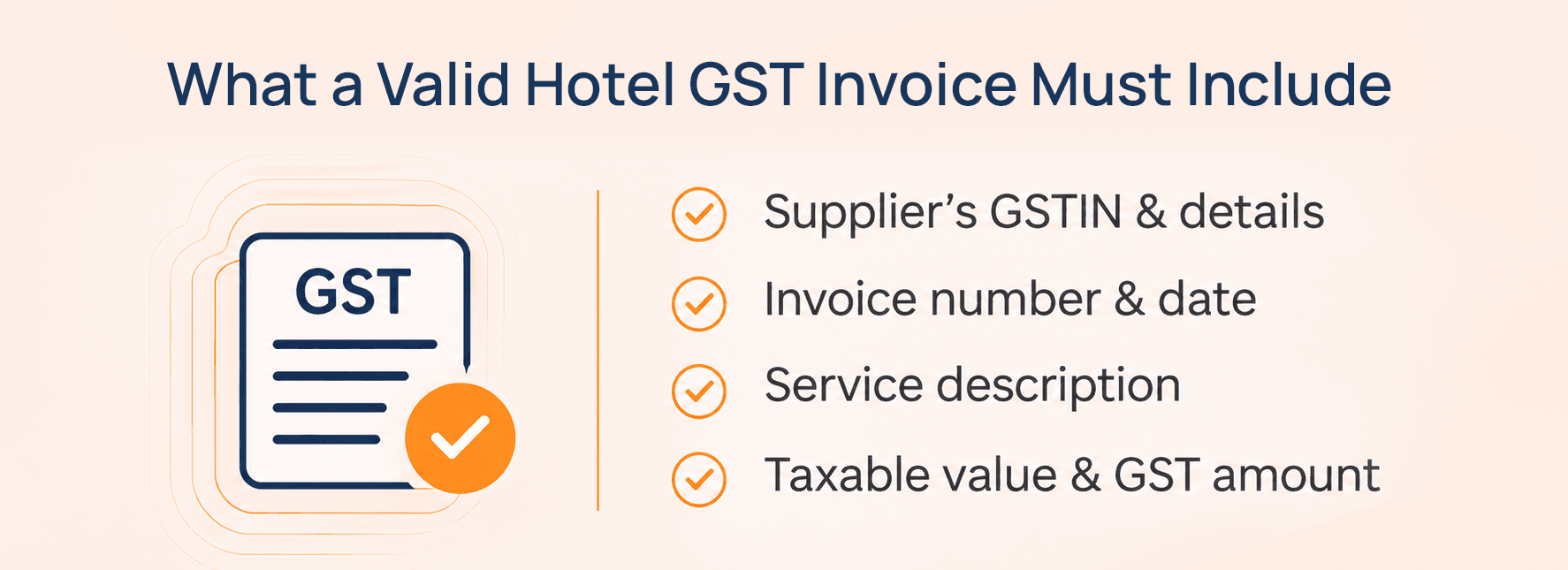
For businesses intending to claim input tax credit, obtaining a valid tax invoice is particularly important. Under Rule 46 of the CGST Rules, a GST tax invoice must contain prescribed information.
Finance teams should check for the following details:
- Hotel's legal name, registered address and GSTIN
- Consecutive invoice number and invoice date
- Name, address and GSTIN of the registered business recipient
- Description of accommodation services
- Total value and taxable value of the supply
- Applicable GST rate and tax amount
- Place of supply, wherever applicable
Other prescribed particulars, including whether tax is payable under reverse charge.
One common issue in corporate travel is employees booking rooms using personal details instead of the company's billing information.
If the business intends to claim ITC, employees should provide the appropriate company GSTIN during booking or before the hotel generates the final invoice.
Organisations operating across multiple states should also ensure that the GST registration used for the booking is appropriate for the transaction. Hotel accommodation is generally governed by the place-of-supply provisions linked to the location of the immovable property.
A missing or incorrect GSTIN can create additional work during invoice reconciliation and may affect the company's ability to substantiate its ITC claim.
Source: CBIC – GST Invoice Rules, Rule 46.
4. Can businesses claim ITC on hotel accommodation?
Yes. Businesses registered under GST can generally claim input tax credit on hotel accommodation used in the course or furtherance of business, subject to the conditions under Section 16 and applicable restrictions under Section 17 of the CGST Act.
This is relevant when employees stay at hotels for official travel, client meetings, training programmes, project assignments or business events.
However, businesses must satisfy the prescribed conditions before claiming credit.
These include:
- The accommodation must be used for business purposes
- The company must possess a valid tax invoice issued by a registered supplier
- The business must have received the accommodation service
- The supplier must report the invoice appropriately, and the applicable ITC conditions, including invoice communication in GSTR-2B, must be satisfied
- The credit must not be restricted under Section 17 of the CGST Act
Does the 5% GST rate mean businesses cannot claim ITC?
Not necessarily. This is an important distinction.
The expression 'without ITC' in the 5% hotel accommodation rate primarily restricts the hotel's ability to claim credit on inputs used to provide the specified accommodation service. It does not automatically disqualify the registered business customer from claiming the GST charged on its hotel bill.
The recipient's eligibility is assessed separately under the normal ITC provisions, including the business-use and documentation requirements.
Businesses should also distinguish accommodation expenses from restaurant bills and other hotel services, which may have different GST treatment and ITC restrictions.
Sources: CGST Act – Section 16 and CBIC – Input Tax Credit Rules.
5. How can businesses improve GST compliance in hotel bookings?
Hotel GST compliance is not simply an accounting activity. It begins with the booking process and continues through invoice collection, expense reporting and reconciliation.
As corporate travel volumes increase, managing these activities manually can make it difficult for finance teams to maintain consistent documentation and visibility into travel expenditure.
Businesses can improve their processes through a few practical measures.
Capture GSTIN details at the booking stage: Employees should have access to the correct company GST registration details when making hotel reservations.
Standardise invoice collection: Establish a process for collecting hotel tax invoices rather than relying only on booking confirmations or payment receipts.
Verify invoices before reimbursement: Check the supplier GSTIN, recipient details, taxable value and applicable GST rate before processing travel expenses.
Reconcile invoices with GST records: Finance teams should regularly verify eligible invoices against GSTR-2B and identify discrepancies that require follow-up.
Maintain visibility into hotel spending: Monitor accommodation expenditure by employee, department, destination and project to identify spending patterns and improve budget control.
Corporate travel management platforms can support these processes by bringing bookings, expense records and travel-spend information into a more structured workflow.
Final Thoughts
Hotel GST is an important consideration in corporate travel management, particularly for organisations handling frequent employee travel across multiple locations.
Understanding the applicable hotel GST rate, collecting accurate tax invoices and identifying eligible ITC can help businesses strengthen financial controls and improve visibility into travel expenditure.
More importantly, GST compliance should not be treated as an activity that begins after an employee completes a trip. It should be considered throughout the travel lifecycle, from booking and billing to expense reporting and reconciliation.
For organisations looking to improve control over corporate travel expenditure, connecting travel bookings with expense management and financial reporting can make tax documentation and spend governance more consistent.

Disha Chatterjee
Senior Content MarketerIn this article
1.What is the hotel GST rate in India in 2026?
2.How does GST on hotel booking work through an OTA versus direct booking?
3.What should a valid hotel GST invoice contain?
4.Can businesses claim ITC on hotel accommodation?
5.How can businesses improve GST compliance in hotel bookings?

Related Blogs