GST & ITC on Flight Bookings - A Handbook for Smarter Travel and Expense Management
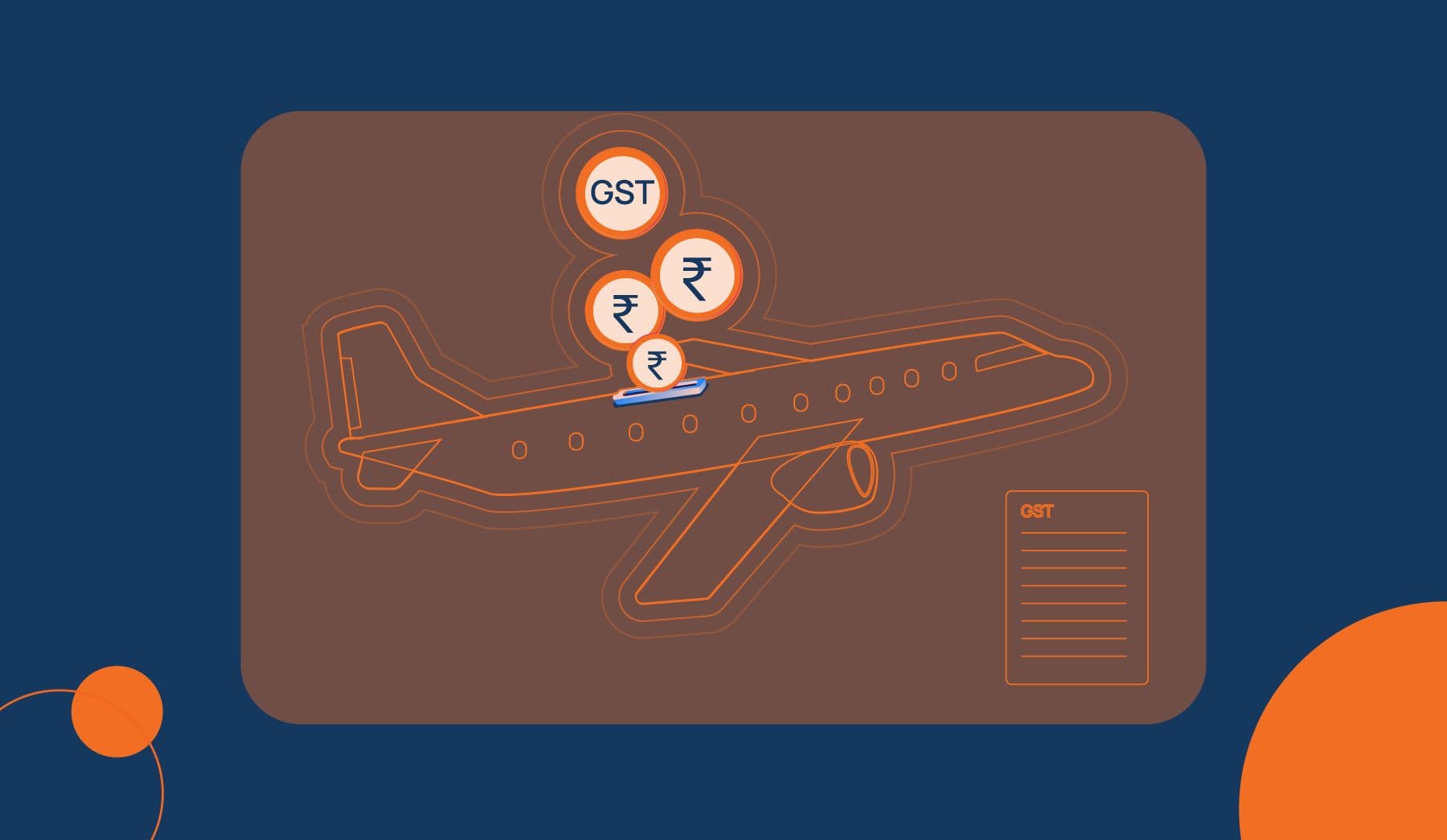
India’s corporate travel market is booming and is expected to double from US $10.6 billion to US $20.8 billion by 2030 (source). With the rise in business travel, the challenges of cost control and GST compliance are growing in equal measure.
For corporates and SMEs, understanding GST on flight tickets is no longer optional, it’s key to smarter expense management. Domestic economy-class fares attract 5% GST, business class 12%, while international flights from India are generally zero-rated (no GST on fare, though ancillary services may still be taxable).
When managed right, these details can translate into meaningful savings through Input Tax Credit (ITC), turning every compliant flight booking into a cost advantage.
GST on Domestic vs International Flight Tickets*
For domestic air travel, GST applies based on the class of travel (source).
- Economy Class: 5% GST on the base fare
- Business or First Class: 12% GST on the base fare
For instance, a domestic business-class ticket priced at ₹10,000 before tax would attract ₹1,200 GST, while an economy ticket would attract only ₹500. This difference becomes significant when scaled across hundreds of trips per year.
International flights from India are typically zero-rated - GST doesn’t apply to the fare, but ancillary services like seat upgrades or meals can still be taxable. It’s crucial for travel and finance teams to distinguish between fare components and add-on services to understand where GST applies. 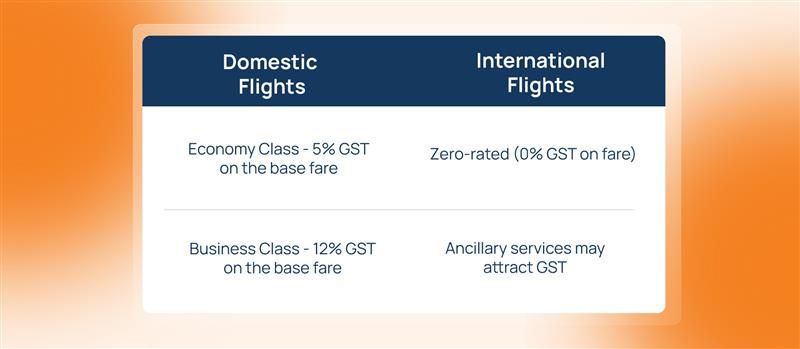
Upcoming tax reforms may also affect these rates. The GST Council has proposed revising slabs under a two-tier structure (5% and 18%) by late 2025. For corporates, this underscores the importance of regularly updating travel budgets and tax configurations in line with policy changes (source).
* As per GST rates effective November 2025
Eligibility for Input Tax Credit
The ability to claim ITC on flight bookings can make a tangible difference to corporate travel ROI. However, it comes with conditions. Only GST-registered businesses can claim ITC, and only when the travel is for official purposes. Trips booked for personal reasons, or those lacking a valid business justification, do not qualify. Additionally, the invoice must carry the company’s GSTIN, and the airline or travel agent must file that invoice in their returns so that it reflects in GSTR-2B.
A few key points to remember:
- ITC can be claimed only if GST was paid on the fare
- For zero-rated international flights, there’s no GST to offset
- Economy-class travel often allows limited ITC eligibility, so confirm with your tax advisor
- The invoice must be GST-compliant, with the correct GSTIN, fare breakup, and GST charged
Step-by-Step Process to Claim ITC
To ensure you never miss eligible ITC, your travel and finance teams should follow a systematic approach:
- Provide GSTIN during booking: Always enter your company’s GSTIN when booking flights through a travel management company (TMC) or corporate portal.
- Obtain a valid tax invoice: Ensure it displays both the airline’s and your company’s GSTIN, along with the GST amount and class of travel.
- Cross-check in GSTR-2B: Verify that the airline’s invoice is accurately reflected in your GSTR-2B statement, as discrepancies can result in disallowance of ITC.
- Maintain supporting records: Keep boarding passes, travel approvals, and expense claim documentation for audit purposes.
- Include the claim in GST returns: Report eligible GST paid in your monthly or quarterly return under ‘Eligible ITC’.
For international bookings, confirm whether GST was charged at all. If not, ITC won’t apply. Centralized booking through a corporate platform like TripGain helps automate much of this compliance.
Common Challenges and How to Avoid Them
Even large enterprises face hiccups in claiming ITC on flight bookings. Some of the most frequent issues include:
- Incorrect or missing GSTINs on invoices, a small typo can render ITC invalid
- Vendor mismatches where the airline fails to upload the invoice in its returns
- Invoices issued in employees’ names without linking to the company’s GSTIN
- Personal or mixed-purpose travel being incorrectly claimed as business
To mitigate these risks, use a centralized booking system that automatically captures GSTINs, validates invoices, and syncs with accounting workflows. A platform integrated with OCR (Optical Character Recognition) can also detect invoice errors before filing - reducing manual oversight and ITC rejection risk.
Best Practices for Smarter Travel & Expense Management
Building GST compliance into travel and expense (T&E) processes isn’t just good practice; it’s strategic.
- Create a clear travel policy that defines eligible business travel, class limits, and invoice requirements
- Centralize all bookings through a TMC or SaaS-based expense platform to ensure GST-compliant invoices and unified record-keeping
- Digitize and automate invoice validation using OCR and AI tools that extract and verify GST data
- Track and reconcile GST credits periodically to identify missed claims or vendor mismatches
- Stay updated with GST Council changes to adjust your travel budgets and claim policies accordingly
Companies adopting modern travel management solutions like TripGain are already leveraging these practices - streamlining bookings, tracking GST on air tickets in real time, and integrating expense data directly with their accounting systems.
Final Thoughts
For CFOs, travel heads, and finance teams, understanding GST on flight tickets and the process of ITC on flight booking is no longer optional, it’s a vital part of cost governance.
By getting GST rates right (5% on economy, 12% on business), ensuring compliance with ITC eligibility rules, and leveraging digital tools for automation, businesses can turn travel into a more intelligent, tax-efficient operation.
In an era where every rupee of spend matters, the smartest companies aren’t just booking flights, they are reclaiming value.
FAQs
1. What are the GST rates on flight tickets?
Economy-class tickets attract 5% GST, while business-class tickets attract 12%. These rates may be revised under upcoming GST reforms.
2. Who can claim Input Tax Credit on flight bookings?
Only GST-registered entities can claim ITC, and only for business-related travel supported by valid invoices.
3. Can ITC be claimed if the invoice is in the employee’s name?
Only if the company’s GSTIN is mentioned and the travel purpose is business-related. Ideally, bookings should be made under the company name.
4. Does ITC differ for domestic and international flights?
Yes. Domestic tickets carry GST (and may qualify for ITC), while most international flights are zero-rated, so no GST or ITC applies.
5. What documents are required to claim ITC?
A GST-compliant invoice, travel itinerary, boarding pass, and proof of business purpose.
6. Can ITC be claimed if no GST invoice is issued?
No. Without a GST invoice, ITC cannot be claimed. Always book through channels that issue compliant invoices.

Disha Chatterjee
Senior Content MarketerIn this article

Related Blogs