Your Next Travel Administrator Might Be a Chat Away
As AI reshapes the workplace, corporate travel and expense management could be the next everyday workflows to move into the conversations where employees already work.
An employee needs to book a flight for a client meeting. Another wants to know whether a hotel falls within company policy. Someone returning from a business trip is trying to figure out why an expense claim is still pending.
These are routine workplace questions. Yet finding the answers can involve switching between booking platforms, policy documents, expense systems, emails, and conversations with a travel administrator or finance team.
The work itself may be straightforward. Finding the right path to get it done is not always so simple.
What if employees could simply ask?
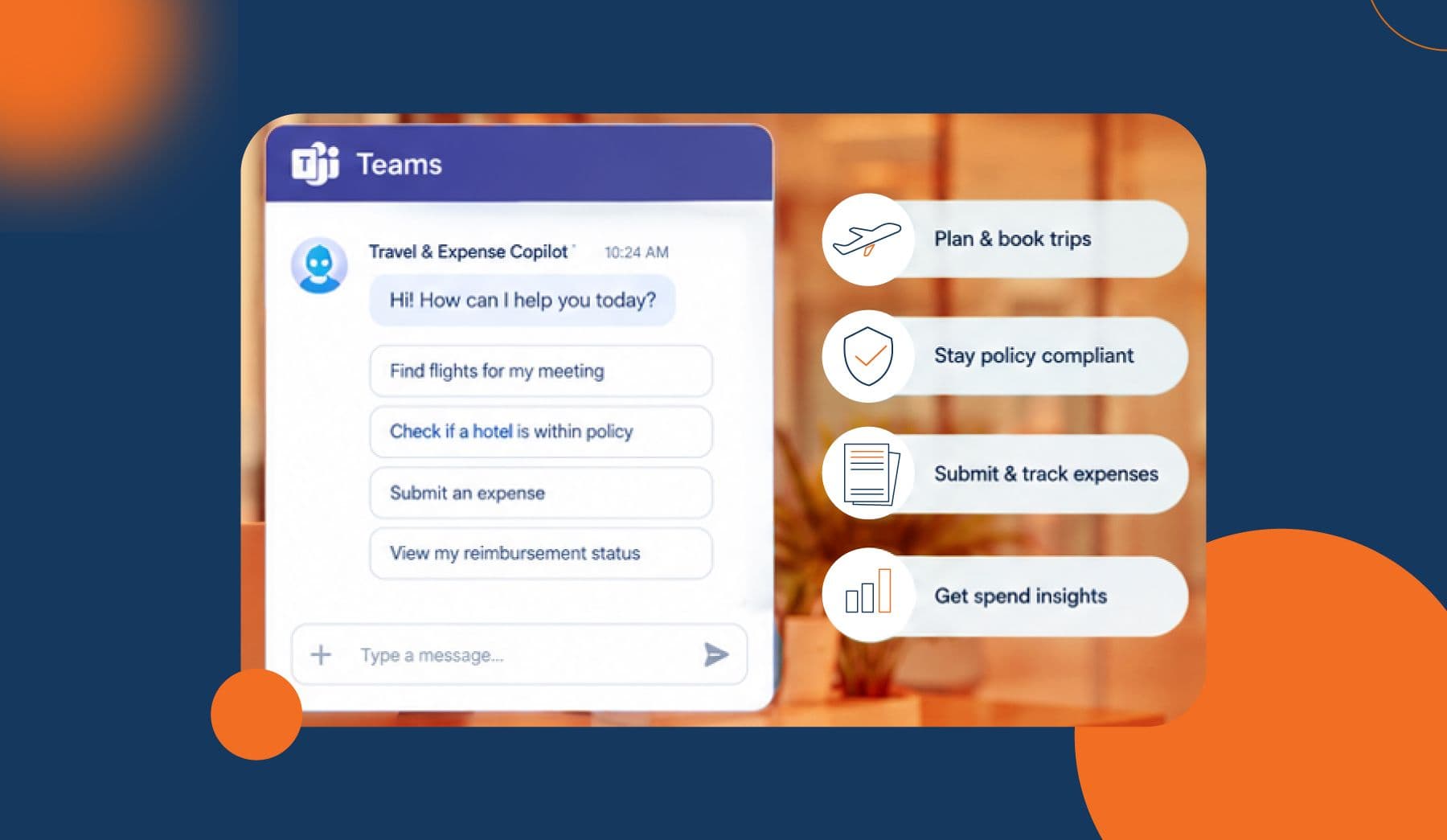
Not in another portal or a separate application, but in the same workplace conversation where they coordinate meetings, discuss projects, and collaborate with colleagues. What if a travel or expense assistant could understand a request in natural language, provide relevant guidance, and help initiate the next step?
It is a small change in how employees access a service, but it points towards a bigger shift in enterprise technology: moving from applications employees must navigate to intelligent assistance that meets them where work happens.
The Hidden Complexity Behind Everyday Travel Requests
Business travel is a significant corporate activity, and its management involves more than booking flights and hotels. Every trip creates a series of decisions around budgets, policies, schedules, approvals, payments, and expenses.
According to the GBTA and Visa India Business Travel and Payments Study, India's business travel spending reached $37.2 billion in 2024, with the market projected to grow by 15.5% in 2025. As travel activity expands, organizations must manage not just higher spending but also the processes that govern it.
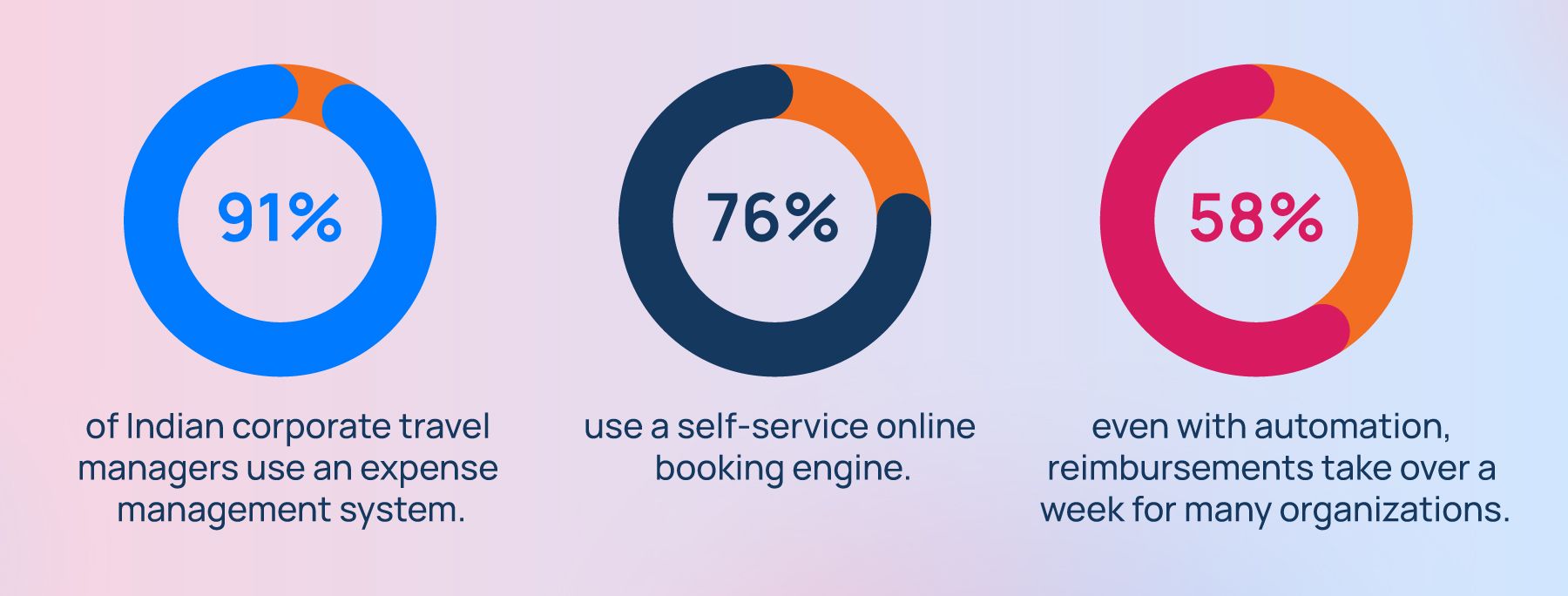
Technology adoption is already substantial. The same study found that 91% of surveyed Indian corporate travel managers used an expense management system, while 76% used a self-service online booking engine.
The challenge, therefore, is not necessarily the absence of digital tools. It is how employees interact with them when they need a quick answer or want to complete a specific task.
Consider a simple question: Can I book a hotel near my client's office for two nights within my company's travel policy?
Answering it may require knowing the permitted hotel budget, the booking channel, preferred suppliers, and any approval requirements. If that information is spread across systems or buried in documentation, even a routine decision can become an administrative exercise.
The disconnect goes beyond booking. TripGain's State of Business Travel in India 2026 report, based on responses from more than 200 professionals across HR, Finance, IT, leadership and business travel, found that 58% of organizations with automated travel systems still take more than a week to reimburse employees. The finding highlights an important distinction: digitizing one part of a process does not necessarily make the entire journey faster. When booking, approvals, payments, and expenses remain disconnected, employees can still end up chasing information, and finance teams can still struggle to close the loop.
This raises a more fundamental question. What if employees could ask for help with a trip, an approval, or an expense through a single conversational interface, with the assistant drawing on the relevant systems and workflows rather than simply directing them to another portal?
Research from the GBTA on corporate travel policies highlights another part of the problem. In its 2025 policy study, published in March 2026, 51% of surveyed travel managers in the United States and Canada said their policies exceeded 10 pages. Almost one-third identified unfamiliarity with policy rules as a reason employees broke them.
The implication is worth considering: publishing a policy is not the same as making it easy to follow.
A more conversational approach could help translate policy into guidance that is relevant to the employee's immediate question, at the moment that question arises.
The Workplace is Already Becoming Conversational
Employees increasingly rely on workplace messaging to ask questions, coordinate tasks, and find information. AI is beginning to change what those conversations can accomplish.
Microsoft's 2025 Work Trend Index found that employees were interrupted by a meeting, email, or notification approximately every two minutes during core working hours. Its research also found that 48% of employees and 52% of leaders said their work felt chaotic and fragmented.
In this environment, asking employees to navigate another interface for every routine request can add to the effort involved in getting work done.
Conversational AI offers a different model. Instead of searching through menus and learning where every function sits, an employee can describe what they need in ordinary language. The assistant can interpret the request, retrieve relevant information and, where its integrations and permissions allow, help carry out the appropriate action.
The opportunity extends beyond answering questions. A well-connected AI assistant can interpret a request, retrieve relevant information, recommend a next step, and help execute a task within the permissions it has been granted.
For business travel, that could mean using calendar context to suggest suitable flight options, checking policy compliance before a booking, finding alternatives after a disruption, or helping an employee submit a receipt. For finance, it could mean asking a question about travel spend in plain language and receiving an analysis of budgets, cost centres, vendor spending or unusual patterns without first assembling a report manually.
The difference is significant: conversational AI can become a way to access business workflows and financial intelligence, rather than simply another place to ask general questions.
This is particularly relevant for business travel and expenses because employees rarely think about these activities in terms of software modules.
They think in terms of outcomes:
- I need to get to Mumbai for a meeting tomorrow.
- Is this fare within my company's policy?
- My flight has changed. What are my options?
- How do I submit this expense?
- Has my reimbursement been approved?
These are not requests for a tour of a booking platform or an expense dashboard. They are requests for help.
The opportunity is to make the technology behind these processes accessible through the language employees already use.
Where a Conversational Travel Assistant Could Make a Difference
The value of this approach becomes clearer when viewed through everyday situations rather than a list of AI capabilities.
1. Planning a trip without starting from scratch
An employee receives an invitation to an out-of-city meeting and needs to arrange travel. Instead of opening a booking platform and navigating multiple steps, they could begin with a request such as:
"I need to travel to Bengaluru next Tuesday and return Wednesday evening. Find options that fit my company's travel policy.”
A connected travel assistant could use calendar context, travel preferences, and policy rules to identify relevant options, explain policy considerations, and help the employee proceed with booking.
The process could become even more proactive. When a client meeting with a location appears on an employee's calendar, an assistant with calendar access could identify the travel requirement and suggest suitable flight windows before the employee has to start planning manually.
The important distinction is between simply answering a question and helping the employee move towards completing the task. Actual bookings would still depend on available inventory, required approvals, and the system's permissions.
2. Making travel policy easier to understand
Corporate travel policies are designed to govern spending, but employees may not remember every rule when making a booking.
A conversational assistant could answer questions such as:
"Can I book a hotel above the standard limit if the conference venue is nearby?”
Rather than requiring the employee to interpret a lengthy document, it could explain the applicable rule, identify any relevant exception process, and direct the employee to the appropriate approval workflow.
The same principle applies to questions about meal allowances, per diem limits, permitted transport options, visa requirements, and preferred suppliers.
This approach could make policy guidance more accessible while helping organizations communicate expectations consistently. It would need to use current, organization-specific policy information rather than generate answers from general AI knowledge.
3. Handling changes while employees are on the move
Business travel rarely unfolds exactly as planned. Flights are delayed, meetings move, and return journeys change.
An employee might ask:
“My meeting has been moved to the afternoon. Can I change my return flight?”
A connected assistant could retrieve the relevant itinerary, check available alternatives, and explain any applicable fare difference or policy restriction. Depending on its capabilities, it could then help initiate a change or route the request to a travel administrator.
This matters because disruption management is not just about finding another flight. It also involves communicating alternatives, controlling additional costs, and ensuring the employee knows what happens next.
The benefit is not that every disruption disappears. It is that employees have a more direct way to seek help when plans change.
4. Making expense submission less of a separate task
The journey does not end when an employee returns home. They may still need to submit receipts, categorise expenses, clarify policy requirements, or check the status of a reimbursement.
A conversational expense assistant could respond to a request such as:
“What expenses from my last trip still need to be submitted?”
If connected to the relevant expense records, it could identify outstanding items, explain the submission requirements, and help the employee continue the process.
An employee could also share a receipt through the conversation. An integrated assistant could extract relevant information, match it against available transaction records, and prepare the expense for submission, subject to the applicable checks.
Similarly, an employee asking why a claim has been returned could receive an explanation based on the recorded reason, along with guidance on what needs to be corrected.
This could help reduce avoidable follow-ups between employees and finance teams. It would not eliminate the need for financial controls, audit trails, or human review where required.
5. Giving travel administrators and finance teams more room for complex work
The impact of conversational assistance is not limited to employees.
Travel administrators routinely handle questions about bookings, changes, policy exceptions and supplier options. Finance teams manage expense queries, incomplete submissions, approval delays and reimbursement-related follow-ups.
When routine questions can be answered consistently through an AI assistant, these teams may be able to devote more attention to exceptions, complex decisions and situations requiring human judgement.
The objective is not to remove the human element from travel support. It is to direct human attention where it is most valuable.
Beyond the Traveler: Bringing Spend Intelligence into Everyday Work
Conversational assistance can also change how finance teams interact with travel and expense data. Today, answering a question about spending may involve opening dashboards, filtering spreadsheets, reconciling reports, and waiting for someone to compile the relevant numbers. A natural-language interface offers another way to access that information.
The need for better visibility is already evident. TripGain's State of Business Travel in India 2026 research highlights continuing challenges around spend visibility and the time required to complete expense processes, even as organizations adopt digital travel systems.
The report also indicates that organizations using automated booking platforms were more likely to approve premium travel options when justified than those relying on manual or assisted technology. The reported comparison was 64% versus 14.3%, respectively. This is an association reported by the survey, rather than proof that automation alone causes better decisions.
The broader takeaway is that automation is not the end goal. Decision-makers also need the visibility and controls to make informed spending decisions.
Imagine a finance manager asking, “Which departments are exceeding their travel budgets this quarter?”
Or a procurement leader asking, “Which hotel vendors account for the highest share of our travel spend, and where could we negotiate better rates?”
A finance controller might want to identify recurring policy exceptions, investigate unusual expense patterns, or forecast travel spending for the next quarter. Instead of starting with a report, they could start with the question they need answered.
If the assistant has access to the relevant, up-to-date data, it could return a contextual analysis and help the user investigate further. This makes spend intelligence more accessible to people who need answers but may not have the time or technical expertise to build reports themselves.
The possibilities extend across several areas:
Budget monitoring: Compare actual travel spending against allocated budgets and identify departments or projects that need attention.
Vendor analysis: Understand spending across airlines, hotels, and other suppliers to support more informed negotiations.
Policy leakage and anomaly detection: Identify out-of-policy transactions, recurring exceptions, and unusual spending patterns for further investigation.
Spend forecasting: Use historical spending, upcoming bookings, and seasonality to estimate future travel expenditure.
Cost-centre analysis: Examine spending by department, project, client, or business unit without manually assembling multiple reports.
Carbon reporting: Access corporate travel emissions data to support environmental reporting and sustainability decisions.
These use cases reflect the broader capabilities described in TripGain's AI Spend Copilot, which brings conversational access to business travel and expense analytics.
The same conversational environment could therefore serve two distinct needs: helping employees manage the practicalities of business travel and helping finance teams understand the spending behind it.
That distinction matters. Making a booking easier is one improvement. Making the decisions surrounding that booking more informed is another.
Why Integration Matters More Than Another Chatbot
A conversational interface is useful only if it can do more than produce plausible-sounding answers.
For a travel assistant, that means access to relevant travel options, itineraries, company policies and permitted booking actions. For an expense assistant, it means being able to reference the employee's actual expense records, submission requirements, and claim status where authorized.
Without these connections, employees may receive information but still need to leave the conversation and complete the work elsewhere.
Integration also raises important questions about access and accountability. An assistant must respect employee permissions, protect sensitive travel and financial information, use reliable data, and make it clear when a task requires approval or human intervention.
A chat window is the visible part of the experience. The real value lies in the systems, information, and workflows connected behind it.
That is why bringing specialized AI assistance into an existing workplace environment is a meaningful development. It can reduce the distance between asking for help and acting on the answer, without requiring employees to abandon the tools they already use to collaborate.
From Software Employees Use to Assistance that Works Alongside Them
Enterprise software has traditionally been organized around applications, modules, and workflows. Employees learn where to go, which forms to complete and whom to contact when something goes wrong.
AI introduces the possibility of a different relationship with workplace technology: one in which employees begin with what they need rather than with the interface they must navigate.
Business travel and expense management is a natural area for this shift. The processes are frequent, governed by specific rules and closely connected to employees' everyday work. They involve a combination of information retrieval, routine actions, and decisions that sometimes require human judgement.
The next evolution may not be another destination employees need to remember. It may be a more direct way to access the capabilities that already support their work.
Imagine asking a travel question in a workplace chat, getting policy-aware guidance, arranging the next step and later checking an expense claim - all through a familiar conversation.
The same environment could help a finance manager investigate spending patterns, compare budgets, or identify unusual transactions without having to begin with a dashboard.
Different needs, supported by connected capabilities, could become easier to address without making every user navigate a separate workflow.
The question is no longer just whether AI can help manage business travel and expenses. It is whether that help can become part of the way people work every day.
And that is where the next chapter of conversational enterprise technology could begin.

Disha Chatterjee
Senior Content MarketerIn this article
1.The Hidden Complexity Behind Everyday Travel Requests
2.The Workplace is Already Becoming Conversational
3.Where a Conversational Travel Assistant Could Make a Difference
4.Beyond the Traveler: Bringing Spend Intelligence into Everyday Work
5.Why Integration Matters More Than Another Chatbot
6.From Software Employees Use to Assistance that Works Alongside Them

Related Blogs