
From Prompts to Action - How MCP Is Changing the Way Corporate Travel & Expense Gets Done
Corporate travel has spent years becoming more digital. Employees moved from phone calls to online booking. Expense reports moved from paper to apps. Approvals moved from email to digital workflows. Dashboards replaced spreadsheets.
Yet the experience remains remarkably fragmented.
A traveler may search for a flight in one system, check policy in another, book through a third, receive an itinerary somewhere else, submit expenses through another application, and wait for an approver working in an entirely different queue.
For finance and travel teams, the fragmentation is even greater. Travel data, employee expenses, vendor invoices, approvals, supplier information and reporting can sit across multiple systems and workflows.
Artificial intelligence changes the interface to these systems. But the bigger opportunity is changing what AI can actually do. This is where the Model Context Protocol, or MCP, becomes important.
What is Model Context Protocol?
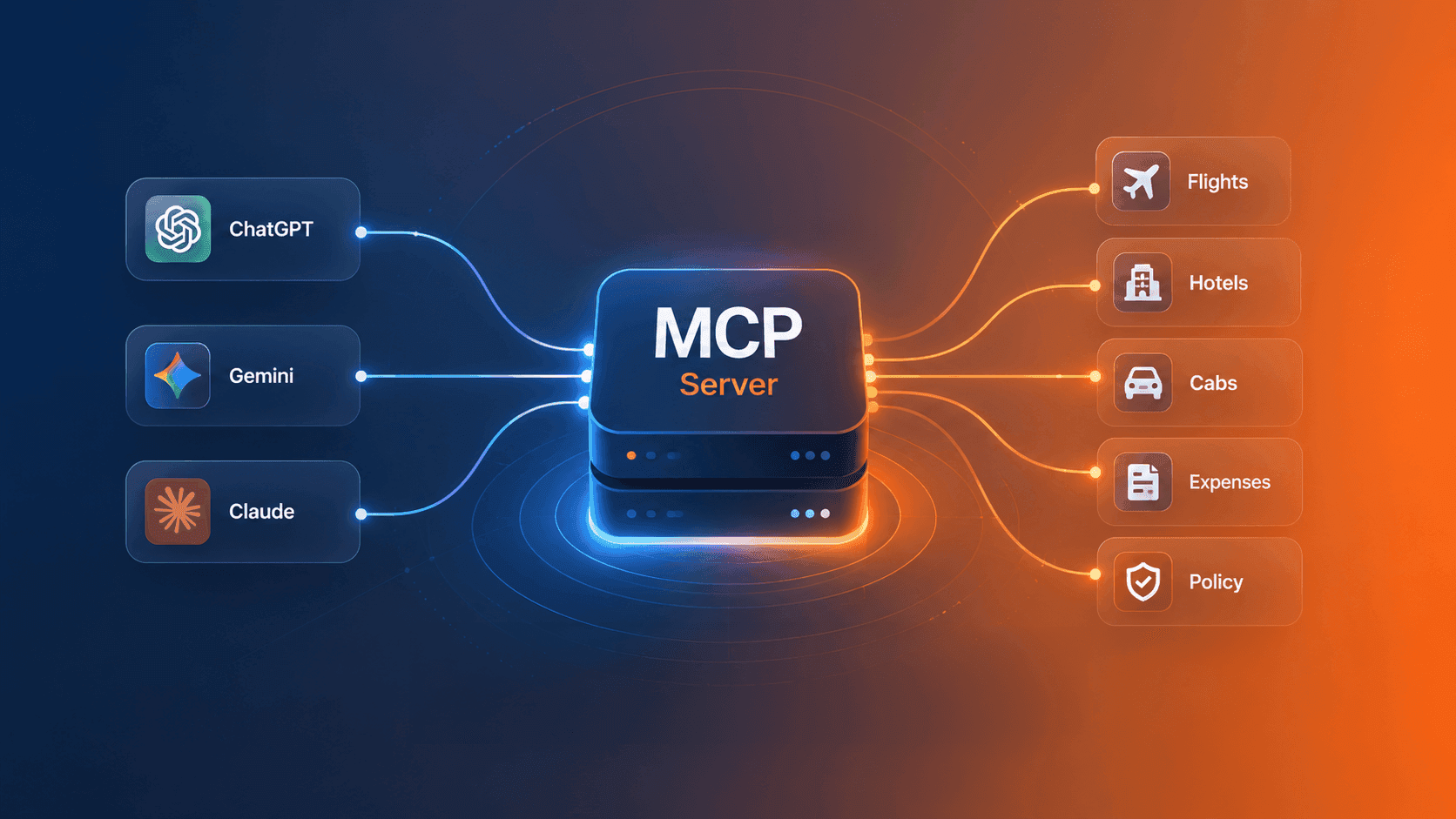
MCP is an open standard for connecting AI applications to external systems, data and tools. The official MCP documentation describes it as a standardized way for AI applications to access external data and perform tasks. The analogy used by the MCP project itself is USB-C: a common connection layer rather than a different connection method for every device.
For corporate travel and expense, however, the protocol itself is not the story.
The opportunity is what becomes possible when AI can securely connect to the systems that govern a business trip - and move beyond answering questions to helping execute the work.
Imagine an employee saying, “Book my Mumbai-Delhi trip next Tuesday. Keep it within policy and prioritize a refundable option.”
Or an employee returning from that trip, “File the expenses from my Mumbai trip.”
An approver could ask, “Show me everything waiting for approval and approve the items that are within policy.”
Finance could ask, “Show this month's travel spend by department and flag anything that is unusually high.”
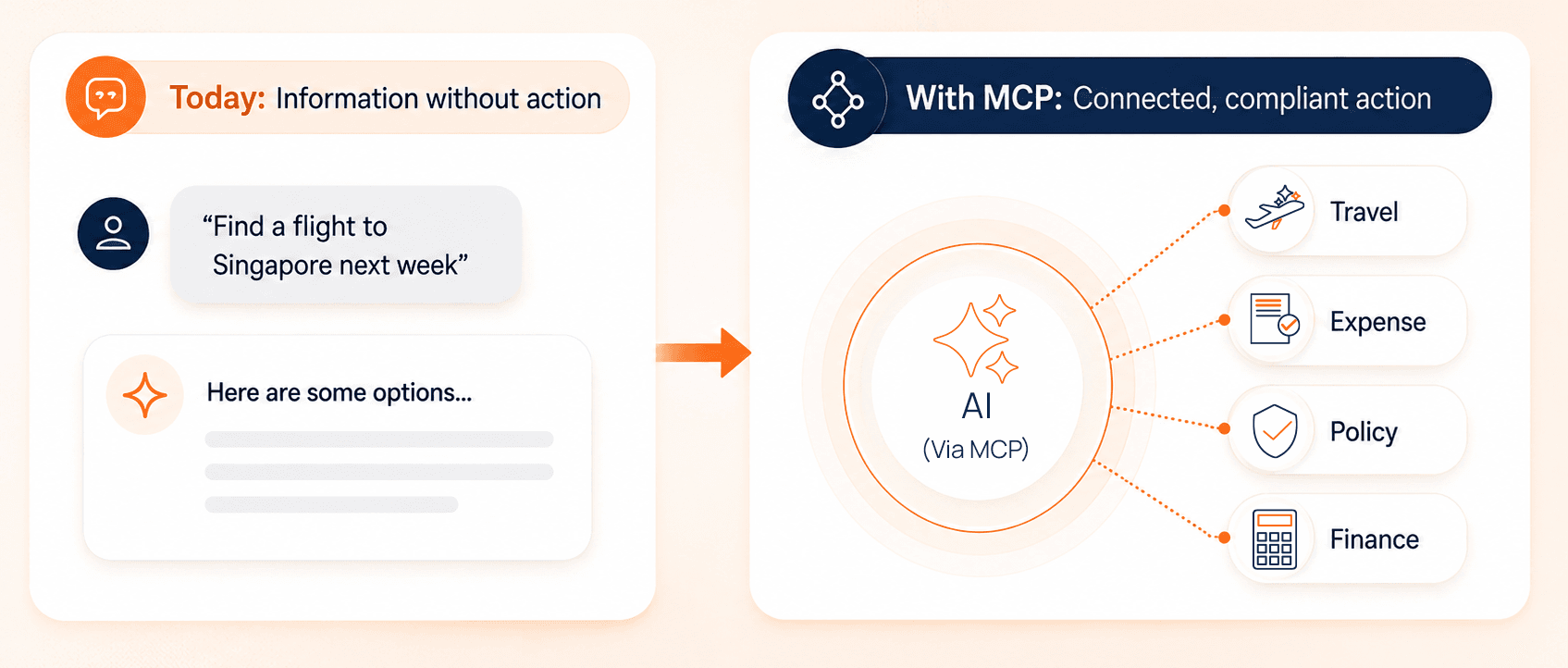
These are not simply better ways to search for information.
They represent a shift from AI that talks about work to AI that participates in the work.
Why This Matters Now
The business travel industry is already moving toward this model, but adoption is still uneven.
GBTA's 2026 research found that 58% of travel buyers said AI had made little or no impact on their travel program to date. At the same time, 92% expressed interest in predictive analytics for travel-spend forecasting and 89% in automated disruption management and rebooking. Only 12% reported having a consolidated view of their travel program from a single data source, while 63% identified a lack of consolidated reporting as a top challenge.
That creates an important tension. The industry wants more intelligent automation. But the underlying environment is still fragmented. The challenge is therefore no longer simply, “Should we use AI?”
The more important questions are:
- What can AI access?
- What is it allowed to do?
- Which business rules does it need to understand?
- Where should humans remain in control?
- How will the organization know whether the connection is actually creating value?
MCP is one part of that answer.
But connecting an AI assistant to a travel and expense platform is only the beginning. To make MCP genuinely useful, organizations need to think about the quality of the underlying data, the actions an agent is allowed to take, policy enforcement, permissions, human oversight, supplier connectivity, security and ultimately measurable business outcomes.
MCP Explained Without the Jargon
At its simplest, it provides a standardized way for an AI application to connect with external systems and use their data, tools, and workflows. The MCP specification defines mechanisms through which AI applications can receive context and access capabilities exposed by connected systems.
Think of the architecture as:
AI Assistant - The conversational interface an employee already uses.
↓
MCP Server - The connection layer that exposes relevant travel and expense capabilities to the AI assistant.
↓
T&E Platform - The underlying system containing travel inventory, policies, expenses, approvals and financial workflows.
↓
Travel & Expense Ecosystem - Suppliers, inventory, employee expenses, vendor expenses, policy rules and financial processes.
The user does not need to understand this architecture. They simply ask for something.
The AI assistant interprets the request. The MCP connection makes relevant capabilities available. The underlying T&E platform applies its business rules and permissions and performs the permitted operation.
MCP is the connection. The workflow creates the value. MCP does not decide whether a traveler should book a particular flight. It does not create a company's travel policy. It does not determine an employee's expense eligibility. Those capabilities come from the business systems connected through MCP.
The protocol provides a standardized mechanism through which an AI application can interact with those capabilities. That means the quality of the underlying business platform remains critical.
An AI assistant connected to fragmented, incomplete or poorly governed data will not suddenly produce a high-quality enterprise workflow.
The strongest implementations combine three layers:
- Intelligence - The AI understands the request and conversational context
- Connectivity - MCP provides a standardized way to access relevant enterprise capabilities
- Execution - The underlying T&E platform applies policies, permissions, and workflows and performs the authorized action
That is the foundation of useful agentic travel and expense.
From Interface to Infrastructure
The most important change is not simply that employees can chat with their travel platform. It is that the AI assistant can become a new interface to capabilities that already exist inside the enterprise.
The booking tool, expense application, and approval workflow do not necessarily disappear. Instead, employees gain another way to interact with those systems - one that understands natural language and, where authorized, can execute tasks.
This distinction becomes increasingly important as organizations adopt multiple AI assistants and agents. The objective is not to replace every enterprise application with a chatbot. It is to make the systems an organization already relies on accessible to the new generation of AI interfaces. MCP makes that connection possible. The underlying enterprise systems determine what the AI can actually accomplish.
Why Corporate Travel & Expense Is Ready for Agentic AI
Corporate T&E has several characteristics that make it particularly suited to connected AI.
Rules already exist
Travel and expense processes are governed by well-defined policies - from preferred airlines and hotel limits to approval thresholds, class-of-service rules, expense categories, tax requirements, and budget controls - creating clear boundaries within which AI can operate intelligently and compliantly.
Workflows are repeatable
Travel and expense follows recognizable sequences:
Search → Compare → Check policy → Book → Approve → Travel → Expense → Reconcile → Report
The more structured the workflow, the easier it becomes to identify where AI can assist or act.
The work crosses systems
A business trip rarely exists inside a single application. It touches travel inventory, HR data, policy engines, expense systems, payment systems, accounting platforms and sometimes procurement or ERP environments.
This is where connectivity becomes particularly valuable.
Multiple people participate in the same process
A single trip can involve a traveler, travel manager, approver, finance team, procurement team and supplier. Each person needs a different view of the same underlying process.
A connected AI layer can provide role-specific interaction without requiring every participant to navigate the same interface.
The value can be measured
This may be the most important characteristic. Organizations can measure:
- Time spent booking
- Expense processing time
- Approval turnaround
- Manual touches
- Policy compliance
- Exception rates
- App switching
- Automation rates
- Adoption
- Cost per transaction
That makes T&E a useful environment for proving whether agentic AI is generating real business value.
The opportunity is bigger than automation. The goal should not be to automate every possible task. It should be to redesign the journey around outcomes.
Instead of asking, “Which T&E tasks can AI automate?” ask, “Which T&E outcomes can become easier, faster and more controlled when AI can access the right systems?”
That is the mindset shift that turns MCP from a technical integration into an enterprise capability.
The Agentic T&E Workflow - From Asking to Acting
The most useful way to understand agentic T&E is to follow a request from beginning to end.
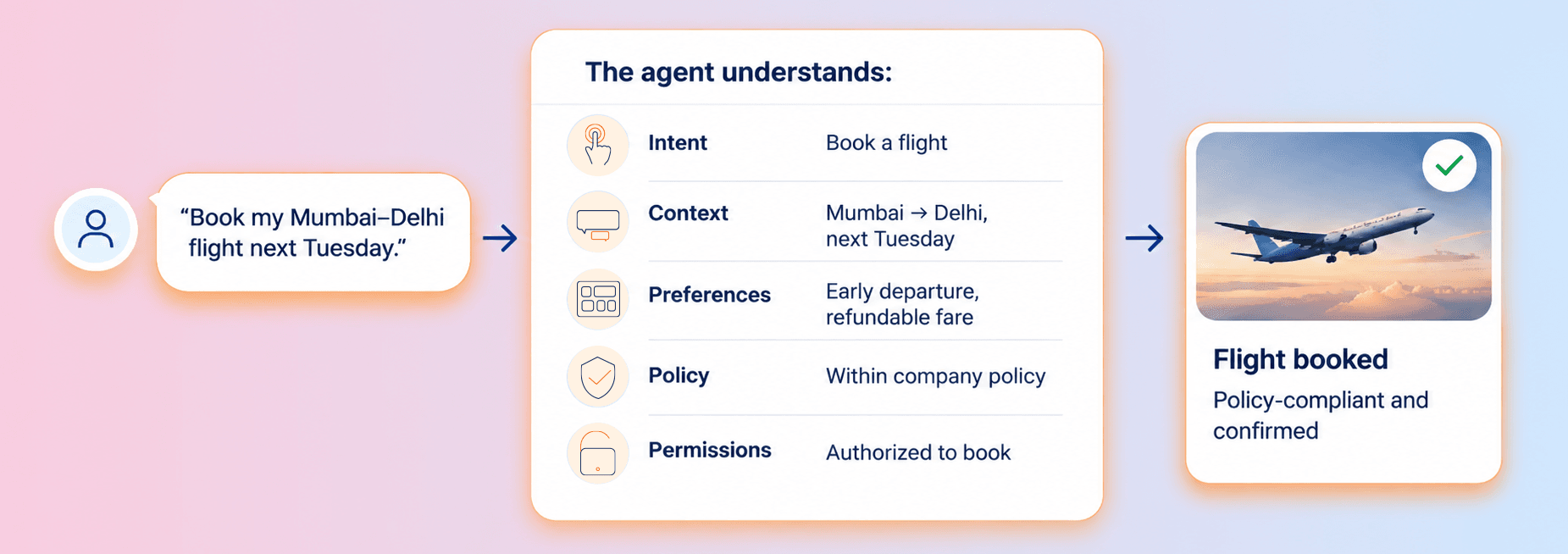
Consider a traveler saying, “Book my Mumbai - Delhi trip next Tuesday. Keep it within policy and prioritize a refundable option.”
A traditional conversational assistant might answer with information. An agentic workflow can potentially go further:
ASK → UNDERSTAND → CHECK → ACT → CONFIRM → RECORD
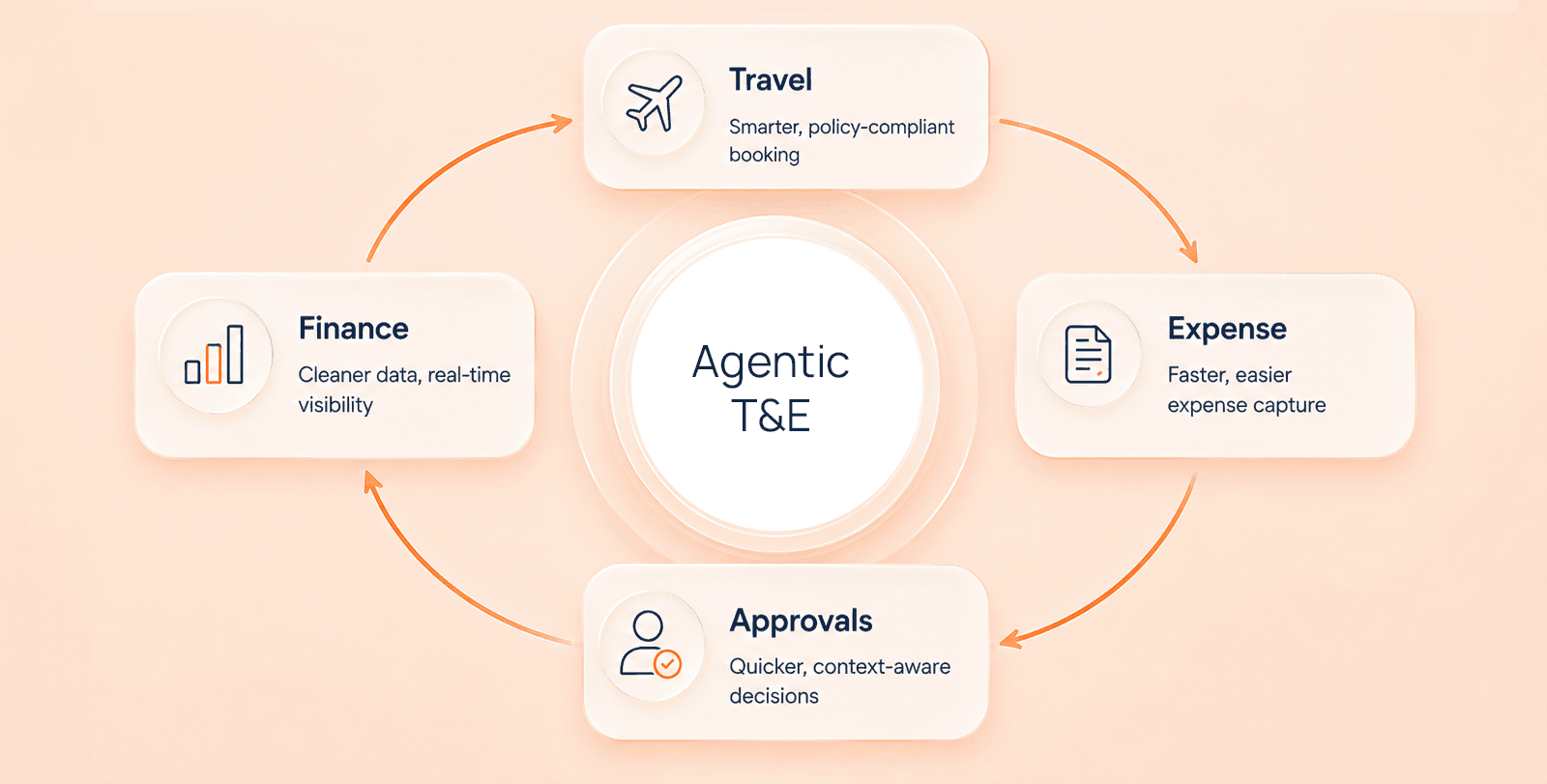
This six-step loop provides a practical framework for designing MCP-enabled T&E experiences.
Ask
The user starts with a natural-language request. The request may be simple, “Book my Delhi trip for Tuesday.” Or it may include several constraints, “Book my Mumbai-Delhi trip next Tuesday. I prefer an early morning departure, keep it within policy and prioritize a refundable fare.”
The advantage of conversational interaction is that users do not have to translate their intent into a sequence of fields before starting the process. The system can begin with the user's objective.
Understand
The AI interprets the request. It identifies the destination, date, traveler, preferences, and other relevant requirements.
If something essential is missing, the agent should ask, for example, “Do you also need a hotel in Delhi?” Good agentic design is about asking the right question at the right time.
Check
Before taking action, the system needs to evaluate the request against business context. That can include:
- Travel policy
- Budget
- Approval requirements
- Traveler preferences
- Preferred suppliers
- Availability
- Existing bookings
- Expense rules
- Role and permissions
This is where connected enterprise systems become important. The AI may understand the request, but the underlying T&E platform supplies the authoritative business rules.
Act
Once the required conditions are satisfied, the system can execute an authorized action.
Depending on the workflow and permissions, that could include:
- Search travel
- Book a flight
- Book a hotel
- File an expense
- Submit an expense
- Surface an approval
- Approve a permitted request
- Process a vendor expense workflow
The critical distinction is between generating an answer and performing an operation. Not every action should be autonomous. Some actions may require explicit confirmation.
For example, “I found three policy-compliant options. The recommended option is ₹14,800 and is refundable. Would you like me to book it?”
The user remains in control. For higher-risk actions, the confirmation boundary may be stricter.
Record
The final action should not disappear into a conversation. The transaction needs to remain part of the enterprise record. The booking, expense, approval, or financial action should flow back into the underlying T&E environment.
This creates an important principle. Conversation can become the interface, but the enterprise system remains the system of record.
Organizations should use the resulting data to understand where users still encounter friction. If travelers repeatedly ask for exceptions to a particular hotel policy, perhaps the policy needs review. If employees repeatedly abandon expense filing, perhaps the process is too complex. If approvers consistently delay certain requests, perhaps the approval threshold needs redesign. Agentic AI should not only automate the workflow. It can also reveal where the workflow itself needs to change.
The Four Core T&E Workflows
Travel: From Search to Booking
A traveler should not need to think in terms of system navigation.
Instead of - open booking tool → select city → select date → search → filter → check policy → compare → book, the interaction can become, “Find me a policy-compliant hotel in Bengaluru for two nights next week, close to my meeting location, with free cancellation.”
The AI can interpret the request and retrieve relevant options through the connected travel platform. The real value comes from combining intent + context + inventory + policy.
A generic AI may know what hotels exist. A connected T&E agent can potentially know what is available through the company's travel ecosystem, what is within policy, and what the traveler is permitted to book.
Employee Expense: From Filing to Flow
Expense management is another strong use case because the process is repetitive and rules-driven. A user might say, “File the expenses from last week's client visit.” The workflow can involve: Identify trip → retrieve expenses → categorize → validate → apply policy → prepare submission → confirm → record
For organizations operating in India, GST readiness adds another layer of value.
Instead of treating the expense as a standalone receipt, the system can maintain the information needed for downstream financial processes.
The objective is not simply to reduce typing. It is to reduce the number of manual steps between spending and usable financial data.
Approvals: From Queues to Decisions
Approval workflows are often slowed down not because the decision is difficult, but because the approver has to find the request. A conversational interface can reverse that.
Instead of opening an approval queue, “Show me all pending travel requests”, say “Approve the requests that are within policy and under my approval limit.”
For exceptions, “There are three requests outside policy. Show me why each one needs an exception.”
The agent becomes a way to surface the decision context. But approval is precisely where human judgment matters. An enterprise should define clearly which actions can be automated and which require human authorization.
Finance & Reporting: From Finding Data to Asking Questions
Finance teams often have the data they need but spend time locating, combining, and interpreting it. A connected assistant can change the interaction model.
For example:
- “Show T&E spend by department for July.”
- “Which department increased spend the most?”
- “What categories drove the increase?”
- “Show me the top vendors behind that change.”
This is more than a dashboard replacement. It introduces a conversational layer for exploring enterprise information.
The Same Connection, Different Experiences
One of the most powerful characteristics of connected T&E is that the underlying system can remain the same while the interaction changes by role.
Traveler - “Book my trip within policy.”
Expense filer - “File my expenses from this trip.”
Approver - “Show me what needs approval.”
Finance - “Show me this month's spend.”
Travel manager - “Which bookings are outside preferred suppliers?”
The interface adapts to the user. The enterprise rules remain underneath. That is the beginning of an agentic operating model for T&E.
The Role-Based and Prompt Playbook
A common mistake when introducing AI is to begin with the technology. A better starting point is the user.
Different T&E stakeholders have different goals, constraints, and definitions of success. The same connected system can therefore create very different experiences depending on who is using it.
The Traveler
For travelers, the biggest opportunity is reducing friction. The ideal interaction is not necessarily a longer conversation with AI. It is a shorter path from intent to completed trip.
Basic prompt, “Book my Mumbai-Delhi trip next Tuesday.”
Better prompt, “Book my Mumbai-Delhi trip next Tuesday. I prefer an early morning departure and want a refundable option within policy.”
Advanced prompt, “Find the best policy-compliant Mumbai-Delhi option for next Tuesday. Prioritize an early morning departure, a refundable fare, and my usual airline preference. Show me the best option before booking.”
The difference is not about writing elaborate prompts. It is about giving the agent enough context to make a useful decision.
Traveler prompt formula - Action + destination + timing + preference + constraint + approval boundary
Example- “Book + Mumbai–Delhi + next Tuesday + early morning + refundable + show me before confirmation.”
The Expense Filer
Expense users typically want one thing - get the expense out of the way!
Basic, “File my expenses from last week's trip.”
Better, “Pull the expenses from my Bengaluru client trip last week, categorize them and prepare them for submission.”
Advanced, “Prepare all expenses from my Bengaluru trip last week. Flag anything missing a receipt or outside policy and prepare the rest for submission.”
The third prompt introduces an important principle - Agents should be useful even when they cannot complete everything automatically. Rather than failing because one expense is incomplete, the agent can identify the exception and continue with what can be processed.
The Approver
Approvers need context, not just notifications.
Basic, “Show me my pending approvals.”
Better, “Show me pending travel and expense approvals and highlight anything outside policy.”
Advanced, “Review my pending travel and expense approvals. Group them into within-policy and exception items, and show me the reason for each exception before I decide.”
This moves the AI from being a notification mechanism to becoming a decision-support layer. The final decision can still remain with the approver.
The Finance Team
Finance teams can benefit from conversational access to financial information.
Basic, “Show me T&E spend this month.”
Better, “Show me T&E spend this month by department.”
Advanced, “Compare this month's T&E spend with last month by department and identify the three largest increases. Break each increase down by travel, employee expense, and vendor expense.”
The more structured the underlying data, the more useful these questions become.
The Travel Manager
Travel managers have a different objective. They are not simply trying to complete individual transactions. They want to understand the health of the program.
Useful prompts could include:
“Which bookings this month were outside preferred suppliers?”
“Where are travelers consistently booking outside policy?”
“Which hotel categories have the highest exception rates?”
“Show me the most common reasons for policy exceptions.”
The value comes from moving from transaction management to program intelligence.
The Procurement Team
Procurement can use connected data to understand supplier relationships and spend.
Examples:
“Show total hotel spend by supplier this quarter.”
“Which suppliers account for the largest increase in spend?”
“Compare contracted supplier usage with non-preferred supplier usage.”
This can help turn travel data into procurement intelligence.
A Practical Prompt Framework
A useful prompt does not have to be complicated.
Think in six components:
1. Intent
What do you want done?
Book / file / approve / compare / analyze / report
2. Context
What is the task about?
Trip / expense / department / supplier / employee
3. Constraints
What boundaries matter?
Policy / budget / timing / location / preferred supplier
4. Preferences
What would make the result better?
Refundability / convenience / loyalty / proximity / timing
5. Decision boundary
Should the agent act or ask? “Show me first.”
“Book if within policy.”
“Ask me if there is an exception.”
6. Output
What should the agent return?
Best option / exceptions / summary / comparison / action confirmation
From Individual Prompts to Reusable Workflows
The next step is to move beyond one-off conversations.
Organizations can identify recurring patterns and turn them into reusable agentic workflows. For example, “Business Trip Workflow”
- Identify traveler
- Understand destination and dates
- Check policy
- Search inventory
- Present options
- Confirm
- Book
- Capture itinerary
- Link expenses
- Close the trip
Or:
“Month-End Expense Workflow”
- Identify unsubmitted expenses
- Group by trip
- Check missing information
- Validate policy
- Flag exceptions
- Prepare submissions
- Route approvals
- Reconcile
- Report
This is where the conversation becomes more powerful than a chatbot.
The AI is no longer simply answering questions. It is becoming an orchestrator of connected business processes.
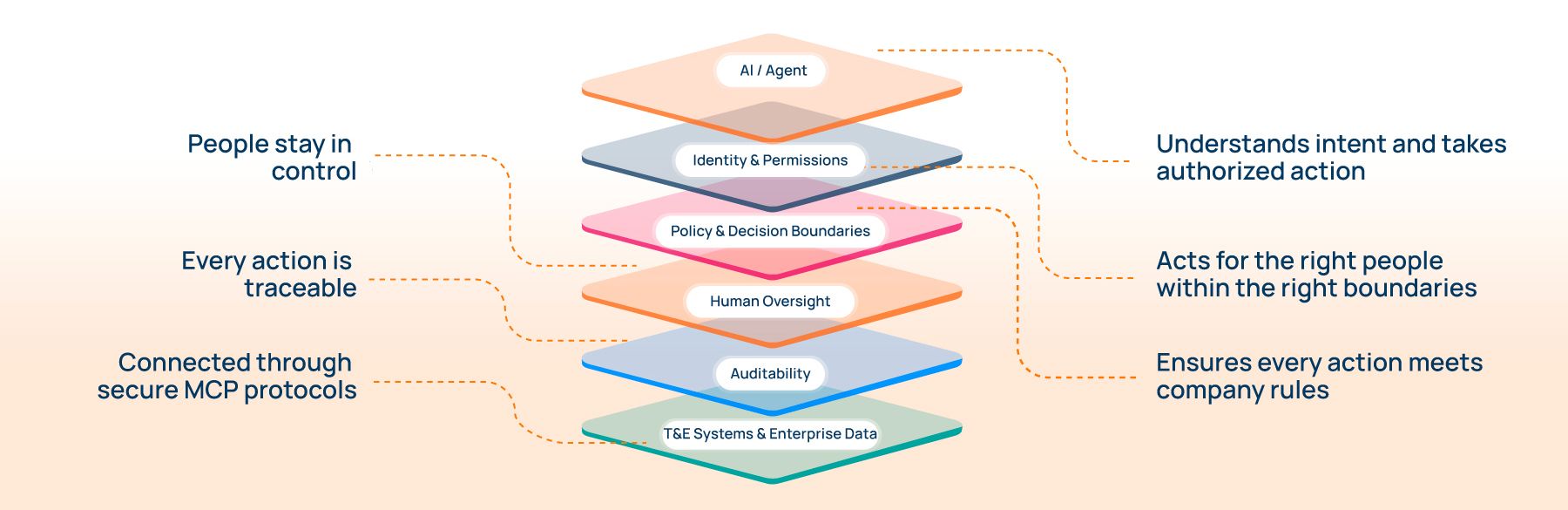
A Key Design Principle: Don't Optimize for Maximum Autonomy
The goal should not be, “How much can the agent do without humans?”
A better question is, “Where does autonomy create value without weakening control?”
Some actions may be low-risk and suitable for automation. Others may require explicit confirmation. And some decisions should remain human-led. The best agentic workflow is therefore not fully autonomous. It is appropriately autonomous.
That distinction becomes essential as organizations move from experimentation to enterprise deployment.
Policy, Security, Governance, & Human Control
The moment an AI assistant can access enterprise systems, the conversation changes.
It is no longer only about convenience. It is about identity, authorization, data access, accountability, and control. This is particularly important in travel and expense because the systems involved contain personal information, financial data, supplier information, and company policies.
MCP itself provides a standardized connection mechanism, but enterprises still need robust implementation-level controls. The MCP specification explicitly emphasizes user consent, control, data privacy and careful authorization of tool use.
1. Identity Comes First
An AI agent should not become a back door into enterprise systems. The connected system needs to know:
- Who is making the request?
- What are they allowed to access?
- What are they allowed to change?
- What approvals are required?
The principle is simple, an agent should inherit appropriate business permissions rather than receive unlimited access simply because it is connected.
For example, a traveler should not automatically gain access to company-wide finance data simply because the same AI assistant can connect to the T&E platform. Access should remain role-aware.
2. Authentication and Authorization
Authentication answers - who are you? Authorization answers - What are you allowed to do?
These should remain distinct. A secure enterprise implementation should consider:
- Strong authentication
- OAuth or equivalent authorization mechanisms
- Role-based access
- Least-privilege permissions
- Token management
- Session controls
- Revocation
- Audit trails
The MCP ecosystem itself has continued evolving in this area. The July 2026 MCP specification introduced additional authorization hardening alongside changes designed to improve scalability and routing.
For an enterprise, however, protocol-level capabilities are only one part of the picture.
The T&E platform and the organization's own identity and security architecture remain critical.
3. Least Privilege Should Be the Default
If an agent only needs to read a user's itinerary, it should not automatically receive permission to modify bookings. If it needs to file expenses, it does not necessarily need permission to approve them. If it needs to show department-level spend, it does not necessarily need access to individual employee banking information.
Give the agent the minimum access required to perform the task. This reduces the impact of mistakes, compromised credentials, or inappropriate instructions.
4. Human-in-the-Loop Is Not a Failure
There is sometimes a misconception that a truly intelligent agent should never ask for confirmation. For enterprise systems, that is the wrong goal. Human oversight can be a feature. Consider three actions:
- Low risk - “Show me my upcoming bookings.” No approval required
- Medium risk - “Prepare my expense report.” The agent can prepare it, but the employee confirms submission
- High impact - “Approve this ₹5 lakh vendor invoice.” The appropriate workflow may require explicit human authorization
The principle should be to automate where the risk is low, confirm where the impact is meaningful, and escalate where judgment is required.
Deloitte's research on agentic AI similarly emphasizes governance, orchestration, and human judgment as organizations scale agentic systems.
5. Policy Should Be an Active Control Layer
A major advantage of connecting AI to an enterprise T&E system is that the agent does not have to make policy decisions from scratch. The system can apply existing rules such as, “Book a hotel in New York for three nights.” The agent should not simply find the cheapest hotel. It should understand the organization's relevant rules:
- Maximum hotel rate
- Preferred suppliers
- Location requirements
- Traveler role
- Approval thresholds
- Booking windows
- Exception requirements
This creates a useful distinction - AI decides how to interact and enterprise policy decides what is permitted.
6. The Agent Should Know When to Stop
A sophisticated agent should recognize uncertainty.
For example, “The requested hotel is above your policy limit. I found two alternatives within policy. Would you like to review them?”
That is better than silently making an exception.
Similarly, “This expense is missing a receipt. I can prepare the remaining expenses and flag this one for review.” The agent continues where it can and escalates where necessary.
7. Auditability Matters
Every important agentic action should leave an appropriate enterprise record.
Organizations should be able to answer:
- Who initiated the request?
- Which agent or application performed it?
- What data was accessed?
- What action was taken?
- What policy was applied?
- Was human confirmation required?
- Who approved it?
- What was the final outcome?
This becomes increasingly important as AI moves from providing information to performing actions.
Deloitte's 2026 research describes agents as effectively becoming new identities within enterprise environments, requiring authentication, authorization, auditing and lifecycle controls similar to human users.
8. Data Quality Is an AI Issue
Agentic AI does not eliminate bad data. It can amplify it. If the underlying policy is outdated, the agent may apply the outdated policy. If supplier data is incomplete, recommendations may be incomplete. If employee profiles are inaccurate, the agent may misunderstand permissions or preferences.
If expense categories are inconsistent, reporting may remain unreliable.
McKinsey's 2026 research makes this point strongly - fewer than 10% of enterprises in its cited research had scaled agents to tangible value, while eight in ten companies cited data limitations as a roadblock to scaling agentic AI.
The lesson for T&E leaders is straightforward - before connecting AI, make sure the systems underneath it are trustworthy.
9. Governance Should Be Designed Before Scale
Governance should not arrive after the first major incident. Organizations should establish:
- Access controls - who can connect?
- Action controls - what can the agent do?
- Approval controls - which actions require human confirmation?
- Data controls - what information can be accessed or shared?
- Monitoring - what should be logged and reviewed?
- Exception handling - what happens when the agent cannot confidently complete a task?
- Accountability - who owns the outcome?
The Enterprise Agent Control Model
IDENTITY (Who is asking?)
↓
CONTEXT (What does the agent need to know?)
↓
POLICY (What is permitted?)
↓
ACTION (What can the agent do?)
↓
CONFIRMATION (Does a human need to approve?)
↓
AUDIT (What happened?)
↓
MONITORING (Is the workflow performing as expected?)
This model can sit alongside the Agentic T&E Loop to create a complete framework.
The Golden Rule
The best enterprise AI experience should feel simple to the employee while remaining sophisticated underneath. The user should be able to say, “Book my trip.”
Behind that simple request, the enterprise may be checking identity, policy, inventory, budget, permissions, and approval rules. The complexity should move into the infrastructure - not onto the employee.
That is where connected AI can create genuine experience improvement without sacrificing enterprise control.
Measuring MCP ROI and Building an Enterprise Maturity Model
If you cannot measure the change, you cannot prove the value. One of the biggest risks with enterprise AI is measuring activity instead of outcomes. It is easy to report, “We connected an AI assistant.”
It is much harder - and much more useful - to answer, “What changed because we connected it?” For T&E, the answer should be measurable.
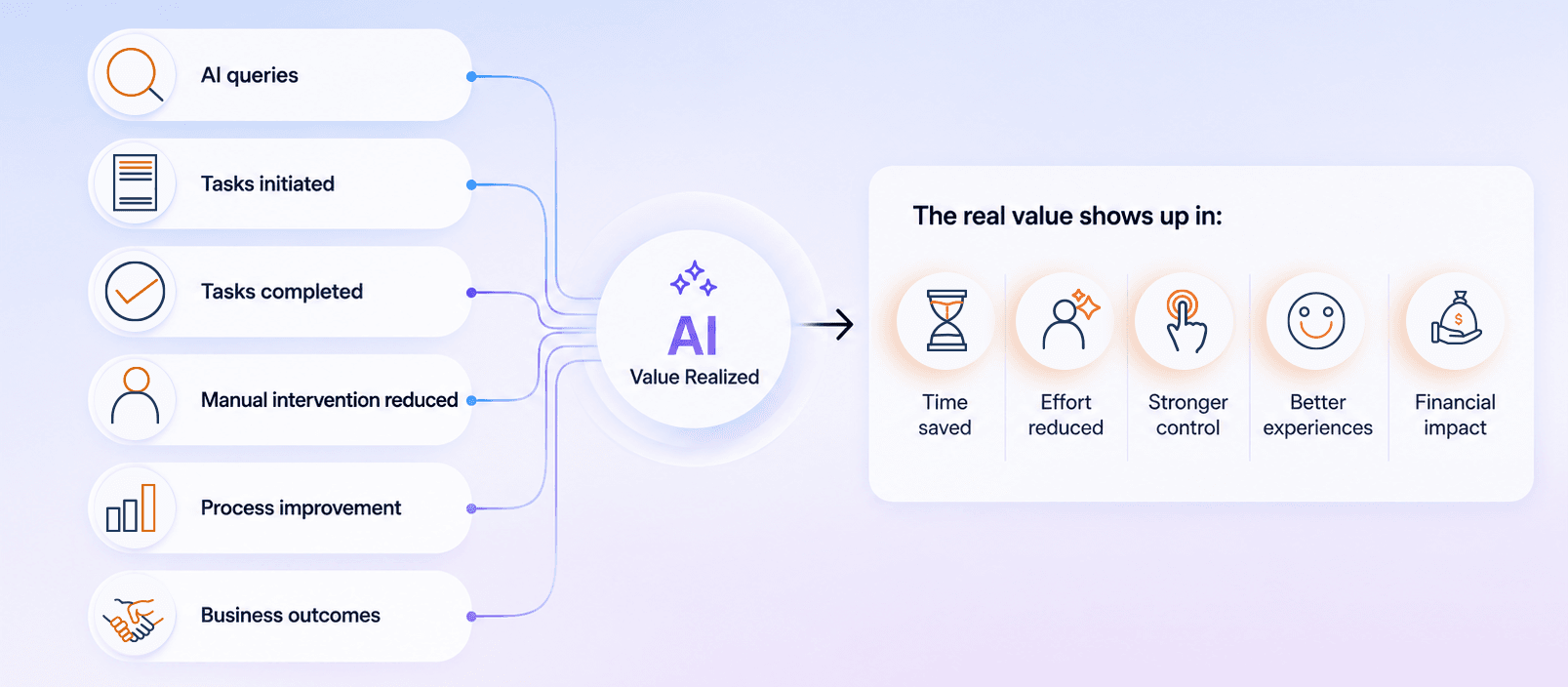
The MCP Value Equation
A practical framework is:
MCP Value = Time Saved + Process Efficiency + Compliance Improvement + Experience Improvement + Financial Impact
Not every organization will measure all five immediately. But the framework prevents AI adoption from becoming a technology vanity metric.
Time Saved
Measure how long common tasks take before and after agentic enablement.
Examples:
- Time to complete a booking
- Time to submit an expense
- Time to find an approval
- Time to answer a spend question
- Time spent switching between applications
Instead of measuring “Employees are adopting the AI assistant,” measure “X% of standard travel requests are now completed through AI, reducing average completion time from X minutes to Y minutes.”
Process Efficiency
Look at the number of manual steps in traditional expense management.
Receipt → Open app → Select trip → Enter amount → Select category → Add details → Attach receipt → Submit
Versus, agentic expense, “File my expenses from last week's trip.” The important metric is not simply the number of clicks. It is the number of manual interventions required to complete the process.
Policy Compliance
A connected agent can potentially make policy enforcement part of the interaction.
Measure:
- Percentage of bookings within policy
- Exception rate
- Out-of-policy spend
- Preferred supplier adoption
- Policy override frequency
The goal is not to eliminate every exception. Some exceptions are legitimate. The goal is to make them visible, explainable, and controlled.
Approval Speed
Approvals often create hidden delays.
Measure:
- Average approval time
- Median approval time
- Number of pending approvals
- Approval aging
- Exception resolution time
If an agent makes it easier for approvers to find and understand pending requests, the impact should appear here.
Employee Experience
Experience should also be measured.
Possible indicators include:
- Adoption rate
- Repeat usage
- Task completion rate
- Abandonment rate
- User satisfaction
- Number of support requests
- App-switch frequency
A useful question is:
"Did the employee need to learn another workflow, or did the workflow adapt to the way the employee already communicates?"
Automation Rate
Track how much of a workflow the agent completes without manual intervention, for example:
- 100 expenses initiated
- 72 completed automatically
- 18 required employee clarification
- 10 required manual review
The resulting automation rate is more meaningful than simply saying, “AI processed 100 expenses.”
Financial Impact
Ultimately, organizations need to connect operational improvements to financial outcomes.
Potential measures include:
- Reduced processing cost
- Lower unmanaged travel
- Improved preferred supplier usage
- Reduced policy leakage
- Faster reconciliation
- Reduced manual finance effort
- Better visibility into vendor spend
Not every benefit will appear immediately as a hard cost reduction. Some create capacity. If a finance employee saves two hours per week, the value may be the ability to redirect that time toward analysis rather than administration.
Measuring the Impact
Before implementing MCP, establish a baseline for the workflows you want to improve. Then track measurable changes across:
- Booking efficiency - time taken to complete a travel request
- Expense efficiency - time and effort required to submit an expense
- Approval speed - time taken to review and approve requests
- Process efficiency - number of manual touches and system handoffs
- Policy compliance - rate of bookings and expenses that follow policy
- Employee experience - completion rates, adoption and support dependency
- Financial impact - savings, spend visibility and processing costs
The goal is to measure what changes in the business, not simply how often people interact with AI.
Do Not Measure Only Usage
A high number of AI interactions does not necessarily mean success. 10,000 AI queries sound impressive. But if users still have to leave the AI interface, open another system and complete the task manually, the actual operational benefit may be limited.
A better dashboard would track: Queries → Tasks → Completed actions → Human interventions → Outcomes
That is the difference between measuring AI activity and measuring AI value.
A Five-Stage MCP Maturity Model
Organizations do not need to jump directly to fully autonomous workflows. A practical maturity model can help.
Stage 1 - Connected
AI can access selected enterprise information.
Example: “Show my upcoming trips.”
Primary value: Visibility
Stage 2 - Conversational
Users can interact with T&E using natural language.
Example: “Show my upcoming trips to Mumbai.”
Primary value: Ease of access
Stage 3 - Contextual
The system uses role, policy, preferences, and business context.
Example: “Find me a hotel in Mumbai within my policy and near my meeting location.”
Primary value: Better decisions
Stage 4 - Actionable
The agent can execute authorized tasks.
Example: “Book the policy-compliant option I selected.”
Primary value: Productivity
Stage 5 - Agentic
The agent coordinates multi-step workflows while maintaining appropriate human oversight.
Example: “Plan my three-day client visit to Mumbai, keep everything within policy, prepare the trip for approval, and flag anything that requires an exception.”
Primary value: Orchestration
The important point is that organizations should not skip the foundations. You cannot build reliable orchestration on unreliable data.
Where Should an Enterprise Start?
A practical approach is to score potential use cases on four dimensions:
- Frequency: How often does the task occur?
- Friction: How much manual effort does it require?
- Structure: Are the rules and workflow clearly defined?
- Risk: What happens if the agent makes a mistake?
High-frequency, high-friction, highly structured and relatively low-risk processes are usually strong candidates for early deployment.
The Business Case for MCP
A compelling enterprise business case should answer five questions:
1. What process are we improving?
2. What does it cost today?
3. What will change with connected AI?
4. What controls will remain in place?
5. How will we measure the result?
This keeps the conversation grounded. MCP should not be justified because it is new. It should be justified because it helps the organization connect intelligence to action in a measurable, governed way.
From Connected Tasks to Connected Operations
The first generation of enterprise AI focused heavily on answers. Employees asked questions and AI generated responses.
The next phase is different. AI can increasingly interact with enterprise systems, use tools and participate in workflows.
MCP is part of the infrastructure enabling that shift. The MCP project describes the protocol as a standardized way for AI applications to connect to external systems, tools and workflows, while its latest 2026 specification continues to evolve around scalability, authorization and enterprise use cases.
For corporate travel and expense, this creates a much bigger opportunity than conversational booking.
From Tasks to Orchestration
Today, an employee might ask, “Book my hotel.” Tomorrow, the request may be closer to, “Plan my client visit to Bengaluru next week.” That single request could involve multiple steps:
Understand the trip → Check calendar → Understand travel policy → Search transportation → Search hotels → Apply preferences → Check budget → Identify approval requirements → Prepare itinerary → Book after confirmation → Connect expenses
The value is not in any one individual action. It is in coordinating the entire workflow. This is where agentic T&E begins to look less like a booking tool and more like an operating layer for business travel and spend.
The Connected T&E Ecosystem
The future is unlikely to be one AI assistant doing everything. It is more likely to be an ecosystem. A company may have:
- A general-purpose AI assistant
- A finance agent
- A travel agent
- An HR agent
- Procurement agents
- ERP-connected workflows
- Supplier-specific services
The challenge becomes making these systems work together. That makes open standards and well-governed connections increasingly important.
MCP's continuing development is significant in this context. The July 2026 specification introduced a stateless protocol core, improved routing, authorization hardening and an extensions framework, with the stated goal of improving reliability, scalability and interoperability.
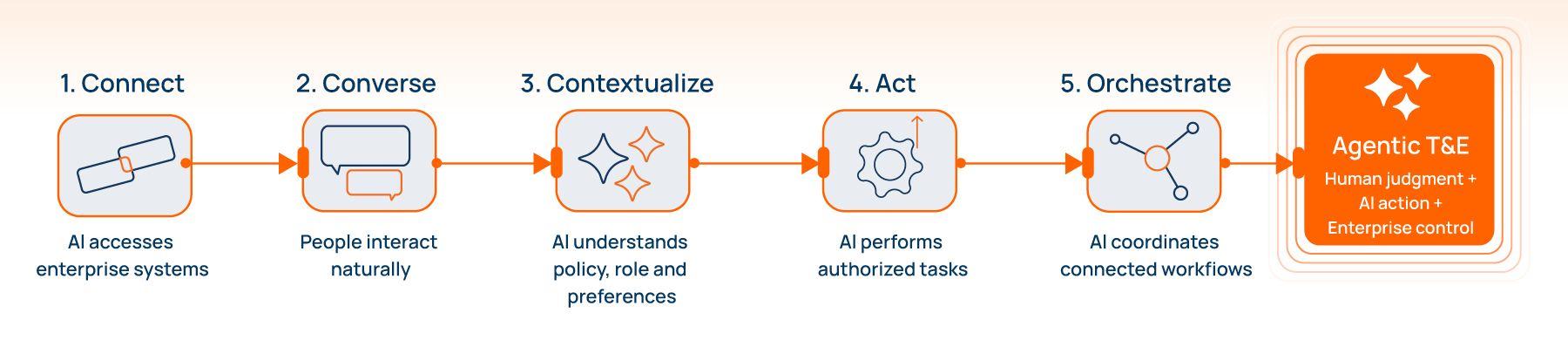
The Enterprise T&E Agent
Imagine a future T&E agent that understands:
- Who you are - Your role, department, and permissions
- Where you are going - Destination, dates, and business purpose
- How you travel - Preferences and historical behavior
- What your company allows - Travel policy and approval rules
- What the company is spending - Budgets, supplier commitments and department-level spend
- What happens next - Approvals, expenses, reconciliation and reporting
The employee does not have to assemble that context manually. The connected system can bring the relevant pieces together. That is the real promise of agentic T&E - context becomes part of the workflow.
The Human + Agentic Operating Model
The future should not be described as Humans vs. AI. A better model is:
- Humans set goals and exercise judgment
- Agents handle structured work and coordination
- Enterprise systems provide authoritative data and rules
- Governance determines the boundaries
This is consistent with broader enterprise research. Deloitte emphasizes that human judgment remains essential as agentic systems scale, while McKinsey describes the future of work increasingly as a partnership between people and intelligent systems.
The most valuable employees may therefore spend less time moving information between systems and more time handling exceptions, making decisions and improving the business.
What Enterprises Should Do Now
Organizations do not need to wait for the technology landscape to settle. They can begin preparing in five ways.
- Map the workflows: Identify the most repetitive T&E processes
- Clean the data: Review policies, employee profiles, supplier data and financial information
- Define permissions: Determine what an AI agent can read, prepare, recommend and execute
- Start with measurable use cases: Choose workflows where value can be demonstrated
- Build governance early: Treat identity, security, auditability and human oversight as part of the design not a later phase
MCP Readiness Checklist
Strategy
- Identify the highest-friction T&E workflows
- Define the business outcome for each workflow
- Establish baseline performance metrics
- Prioritize use cases by frequency, friction, structure and risk
Data
- Review employee and traveler data
- Validate travel policies
- Review supplier and inventory data
- Standardize expense categories
- Establish data ownership
Connectivity
- Identify systems that need to connect
- Determine which capabilities should be exposed to AI
- Evaluate MCP-compatible AI clients
- Define integration and monitoring requirements
Security
- Establish authentication
- Define authorization
- Apply least-privilege access
- Define data-sharing boundaries
- Establish audit logging
- Define credential/token lifecycle
Agentic controls
- Identify read-only capabilities
- Identify action capabilities
- Define actions requiring confirmation
- Define escalation paths
- Define exception handling
Measurement
- Track time saved
- Track manual touches
- Track completion rates
- Track policy compliance
- Track approval turnaround
- Track adoption
- Track financial impact
The Final Principle
Enterprises should not adopt MCP because AI is fashionable.
They should adopt connected AI when it can make a business process:
- Simpler for the employee
- Faster for the business
- More controlled for finance
- More compliant for the organization
- More measurable for leadership
And ultimately, more human where judgment matters, and more automated where machines are better suited to the work.
Corporate travel and expense is particularly well positioned for this transition because it combines structured rules, repeatable workflows, high transaction volumes, multiple stakeholders and measurable outcomes.
The opportunity is therefore bigger than putting a chatbot in front of a booking tool. It is about creating a connected environment where people can express intent naturally, AI can understand the context, enterprise systems can enforce the rules, agents can execute authorized work, and humans can remain in control of consequential decisions.
- MCP provides the connection
- Enterprise systems provide the context
- Agents provide the action
- People provide the judgment
Together, they define the next operating model for corporate travel and expense.
The Human + Agentic Era
The future of T&E will not be about removing people from the process. It will be about removing unnecessary friction from the process.
Less searching, less switching, less copying, less waiting, but more context, control, intelligent action, and more time for people to focus on the decisions that actually matter.
The next generation of corporate travel will not simply be conversational, it will be connected, contextual, and increasingly agentic.

Disha Chatterjee
Senior Content MarketerIn this article
1.What is Model Context Protocol?
2.Why This Matters Now
3.MCP Explained Without the Jargon
4.From Interface to Infrastructure
5.Why Corporate Travel & Expense Is Ready for Agentic AI
6.The Agentic T&E Workflow - From Asking to Acting
7.The Four Core T&E Workflows
8.The Same Connection, Different Experiences
9.The Role-Based and Prompt Playbook
10.From Individual Prompts to Reusable Workflows
11.A Key Design Principle: Don't Optimize for Maximum Autonomy
12.Policy, Security, Governance, & Human Control
13.The Enterprise Agent Control Model
14.The Golden Rule
15.Measuring MCP ROI and Building an Enterprise Maturity Model
16.The MCP Value Equation
17.Measuring the Impact
18.A Five-Stage MCP Maturity Model
19.Where Should an Enterprise Start?
20.The Business Case for MCP
21.From Connected Tasks to Connected Operations
22.From Tasks to Orchestration
23.The Connected T&E Ecosystem
24.The Enterprise T&E Agent
25.The Human + Agentic Operating Model
26.What Enterprises Should Do Now
27.MCP Readiness Checklist
28.The Final Principle