Vendor Expense Management: How Businesses Can Control Rising Corporate Travel Costs

Corporate travel costs are increasing, even as businesses remain selective about the number of trips they undertake. For finance and procurement teams, this creates a growing challenge - controlling travel expenditure without compromising business operations or employee experience.
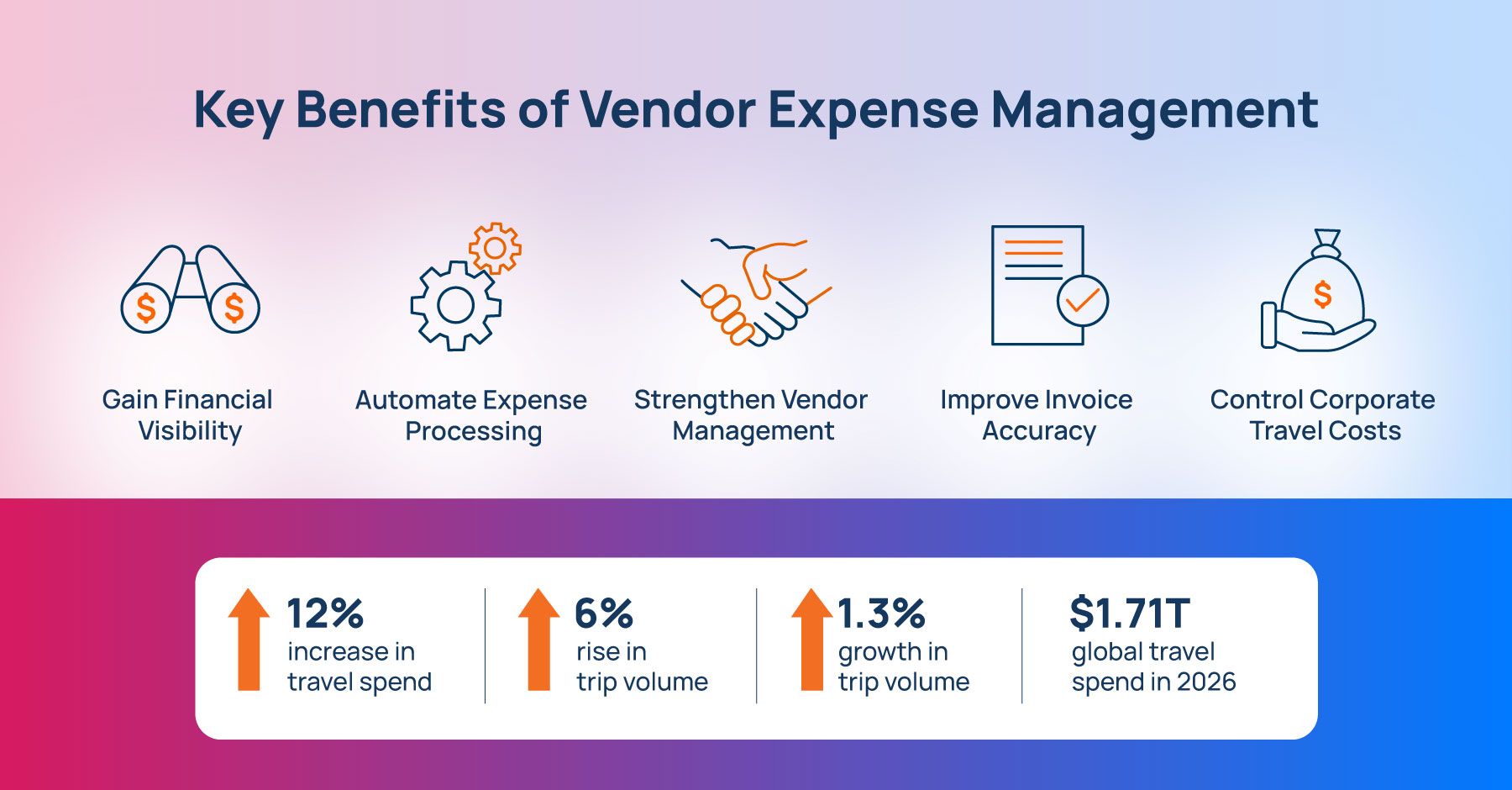
According to Deloitte's 2026 Corporate Travel Study, corporate travel spending increased by 12% in 2026, while trip volumes grew by just 6%. Higher airfare and accommodation rates account for much of this difference.
Similarly, the Global Business Travel Association (GBTA) forecasts global business travel spending of $1.71 trillion in 2026, compared with a 1.3% increase in trip volume.
These trends highlight the importance of looking beyond booking costs. Businesses also need visibility into supplier invoices, payments, approvals, and post-booking expenses. This is where vendor expense management becomes an important part of corporate financial control.
Why Vendor Management Is Becoming Critical for Corporate Travel
Corporate travel involves multiple vendors, including airlines, hotels, ground transportation providers, and travel service partners. Each transaction generates financial records that need to be verified, approved, and reconciled.
When these processes operate independently, finance teams may struggle with inconsistent invoices, duplicate payments, delayed reconciliations, and limited visibility into supplier-level spending.
Effective vendor management helps organizations establish consistent processes for tracking supplier transactions, validating charges, and monitoring payment obligations. It also enables procurement and finance teams to evaluate vendor performance against agreed commercial terms.
Rather than treating each invoice as an isolated transaction, businesses can develop a consolidated view of vendor-related expenditure and identify discrepancies before they affect financial reporting.
Where Businesses Lose Control of Vendor Expenses
Managing multiple travel suppliers creates several opportunities for financial leakage.
- Invoice discrepancies: Supplier invoices may contain incorrect rates, additional charges, or amounts that differ from the original booking.
- Duplicate payments: Repeated invoices or disconnected payment records can result in the same expense being processed more than once.
- Delayed reconciliation: Manual matching of invoices, purchase orders and payment records increases processing time.
- Policy deviations: Expenses incurred outside approved budgets or company policies may go unnoticed without adequate validation.
- Limited supplier visibility: Fragmented financial records make it difficult to understand spending patterns across vendors.
Addressing these issues requires more than periodic financial reviews. Organizations need processes that connect invoice validation, approvals, payment tracking, and reconciliation.
The Role of an Expense Management System in Vendor Expense Control
An integrated expense management system can bring multiple financial workflows into a centralized process, reducing the dependence on spreadsheets and manual verification.
Automation can improve vendor expense management in several ways:
- Automated invoice processing: Optical Character Recognition (OCR) extracts relevant information from invoices, reducing manual data entry, and helping finance teams process documents faster.
- Purchase order matching: Invoice details can be compared against approved purchase orders to identify differences in amounts, quantities, or agreed terms.
- Structured approval workflows: Configurable approval hierarchies ensure that expenses are reviewed by the appropriate stakeholders before payment.
- Payment reconciliation: Integrating payment records with invoice and expense data helps finance teams track outstanding transactions and identify discrepancies.
- ERP integration: Connecting expense workflows with enterprise resource planning systems reduces duplicate data entry and improves the consistency of financial records.
These capabilities help organizations move from reactive expense reviews towards more consistent financial oversight.
How Automation Improves Vendor Management and Expense Accuracy
As corporate travel programs become more complex, automation is increasingly important for managing financial transactions at scale.
Research from Mastercard's 2026 study on the connected future of travel and expense management, based on 1,773 T&E decisionmakers across 15 countries, highlights the need for greater connectivity between travel, payments, expense, and financial systems.
The findings reinforce an important point - disconnected systems limit visibility and make it harder for businesses to exercise financial control.
By connecting these workflows, organizations can reduce manual intervention, improve invoice accuracy, and establish clearer audit trails. Finance teams can also use consolidated reporting to identify recurring discrepancies, monitor supplier spending, and make better-informed procurement decisions.
Building a More Accountable Corporate Travel Expense Process
Controlling corporate travel costs requires visibility across the entire expense lifecycle, from booking and supplier invoicing to payment and reconciliation.
An effective vendor expense management process should bring together invoice automation, purchase order matching, configurable approvals, payment reconciliation and ERP integration.
TripGain's Vendor Expense Management capabilities support these requirements through automated invoice processing with 99% OCR accuracy, Razorpay integration, purchase order matching, seven-level approval workflows, and ERP synchronization.
For finance and procurement teams, this means less dependence on manual processing and greater control over vendor-related transactions.
As business travel expenditure continues to rise, organizations that strengthen their vendor management processes can improve financial accuracy, reduce operational inefficiencies, and make better use of their travel budgets. Ultimately, managing travel costs is not just about securing better booking rates; it is also about ensuring that every supplier expense is accounted for, validated, and reconciled.

Disha Chatterjee
Senior Content MarketerIn this article
1.Why Vendor Management Is Becoming Critical for Corporate Travel
2.Where Businesses Lose Control of Vendor Expenses
3.The Role of an Expense Management System in Vendor Expense Control
4.How Automation Improves Vendor Management and Expense Accuracy
5.Building a More Accountable Corporate Travel Expense Process

Related Blogs