Travel Reimbursement vs Travel Allowance: Tax Rules and Policy Guide
Business travel comes with expenses that extend well beyond flight tickets and hotel bookings. Employees may need to pay for local transportation, meals, airport transfers, and other incidental costs while travelling for work. How companies compensate employees for these expenses can influence everything from employee experience and financial reporting to tax compliance.
Two common approaches are travel reimbursement and travel allowance. Although both help employees manage business travel costs, they work differently when it comes to payments, expense documentation, and tax treatment.
For finance and HR teams, understanding the distinction is essential to building transparent travel policies and maintaining control over business travel spending. Here is how travel reimbursement and travel allowance differ, what the applicable tax rules mean for employees, and how businesses can manage both effectively in 2026.
What Is Travel Allowance?
Travel allowance is a fixed amount an employer provides to an employee to cover expenses associated with official travel. It is generally paid in advance or as part of the employee's salary, depending on the company's travel policy.
For instance, an organisation may provide an employee with ₹3,000 per day to cover meals, local transportation, and other incidental expenses during a three-day business trip.
The employee receives the predetermined amount without necessarily having to submit individual bills for every expense, although the organisation may require supporting documents or a declaration of expenditure.
Travel allowances are commonly structured as:
- Daily allowance: A fixed amount for meals and incidental expenses during official travel
- Conveyance allowance: An amount towards local transportation for work-related activities
- Tour allowance: An allowance covering expenses incurred during an official business trip
- Mileage allowance: Compensation for using a personal vehicle for official travel, usually calculated using a per-kilometre rate
The amount and eligibility conditions typically depend on the organisation's travel policy, employee grade, destination and duration of travel.
What Is Travel Reimbursement?
Travel reimbursement is the process through which an employer repays employees for eligible business travel expenses they have already incurred.
Unlike a fixed travel allowance, reimbursement is generally linked to actual expenditure. Employees pay for approved travel-related expenses and subsequently submit claims with supporting documents such as invoices, receipts, tickets, or payment records.
For example, an employee travelling to Mumbai for a client meeting spends ₹8,500 on airfare, ₹4,000 on accommodation and ₹1,200 on local transportation. After submitting the relevant bills and receiving approval, the employee is reimbursed ₹13,700, subject to company policy.
Common travel reimbursement categories include:
- Flight and train tickets
- Hotel accommodation
- Local transportation and airport transfers
- Business-related meals
- Parking and toll charges
- Other approved incidental expenses
A structured expense reimbursement process helps organisations verify claims, enforce spending limits, and maintain an accurate record of business travel expenditure.
Travel Reimbursement vs Travel Allowance: Key Differences
Although both approaches serve the same broad purpose, their financial and administrative implications differ.
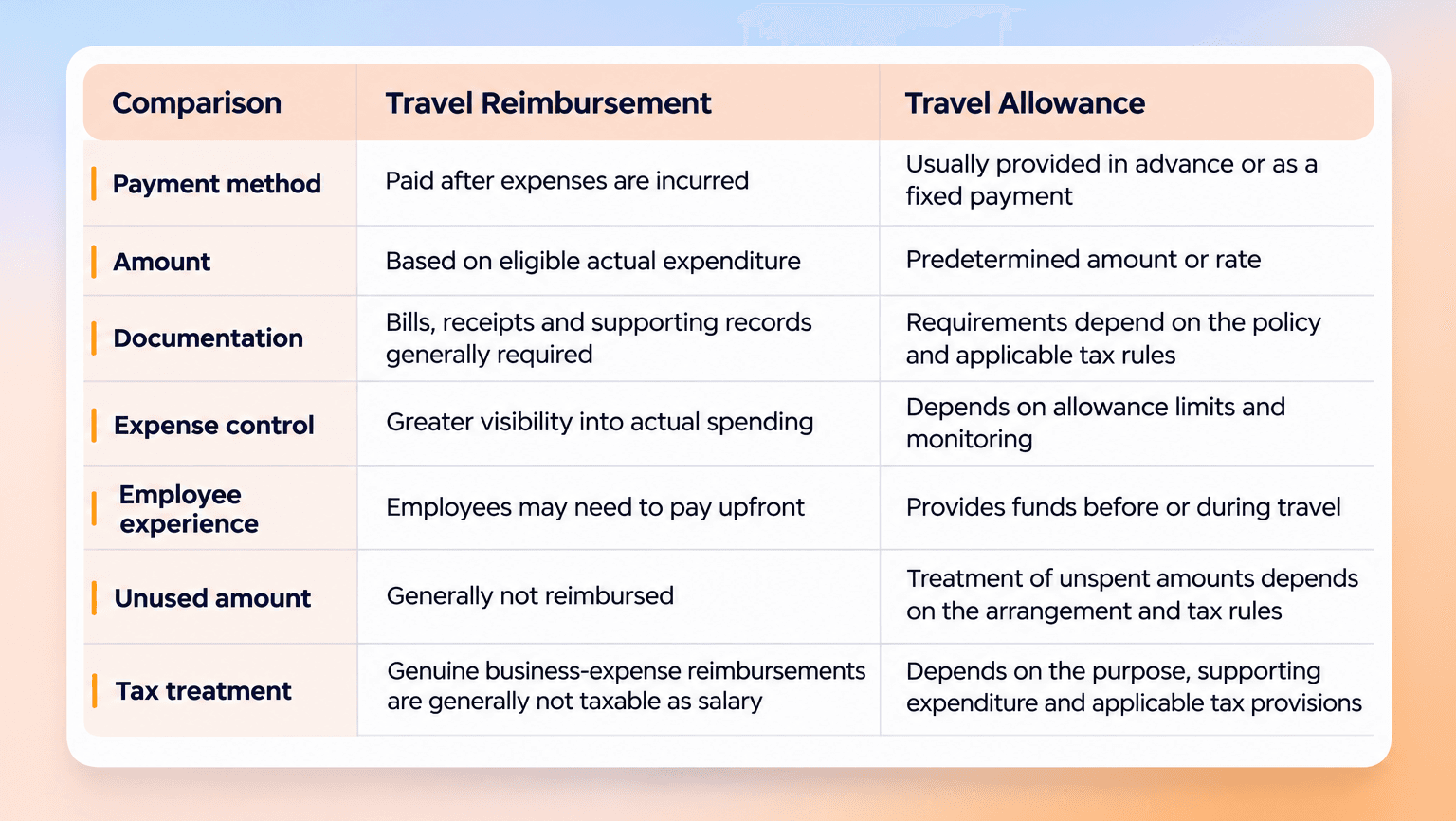
The most significant difference is accountability. Reimbursement gives finance teams a clearer view of what employees actually spend, while allowances provide employees with greater flexibility over how they manage their travel budgets.
Neither approach is universally better. The right structure depends on travel frequency, employee requirements, financial controls and the organisation's tax and compliance framework.
Is Travel Allowance Taxable in India?
This is where the distinction becomes particularly important.
Not every payment labelled as a travel allowance is automatically tax-exempt. Its tax treatment depends on why the payment is made, whether it relates to official duties, and how much expenditure the employee actually incurs.
For the 2026 tax year, businesses should also account for the transition from the Income-tax Act, 1961, to the Income-tax Act, 2025, effective 1 April 2026.
Travel Allowance Exemption Under the Old Tax Regime
Under the earlier Income-tax Act, 1961, Section 10(14)(i), read with Rule 2BB, provided an exemption for specified allowances granted to meet expenses incurred wholly, necessarily and exclusively in performing employment duties. (Income Tax Department – Allowances under Section 10(14))
These included:
- Allowances towards travel expenses during official tours or transfers.
- Daily allowances covering ordinary expenses incurred while employees were away from their normal place of duty.
- Conveyance allowances for official work, where free conveyance was not provided.
The exemption was limited to the actual expenditure incurred for the specified purpose. Any unspent or excess allowance was generally taxable.
For example, if an employee receives ₹12,000 as an official travel allowance but spends only ₹9,000 on eligible expenses, the remaining ₹3,000 does not qualify for exemption under these provisions.
What About the New Tax Regime?
The distinction between official travel expenses and personal allowances is particularly important under the new tax regime.
For the previous tax year governed by the Income-tax Act, 1961, the new regime under Section 115BAC generally did not permit employees to claim the Section 10(14)(i) exemption for prescribed duty-related allowances. Leave Travel Concession under Section 10(5) was also unavailable under that regime.
However, from 1 April 2026, the Income-tax Act, 2025, introduces a revised statutory framework.
Schedule III, Sl. No. 12, read with Rule 280 of the Income-tax Rules, 2026, specifically recognises allowances for official travel, transfers and daily expenses incurred while employees are away from their normal place of duty. These are excluded from taxable income to the extent the qualifying expenditure is actually incurred, subject to the prescribed conditions.
This is distinct from a general personal travel allowance, which does not become tax-exempt simply because an employer describes it as a travel benefit.
Income-tax Act, 2025 – Schedule III
Income-tax Rules, 2026 – Rule 280
Note: Leave Travel Allowance (LTA) and official business travel allowances are different categories. LTA relates to eligible domestic personal travel by employees and their families, subject to prescribed conditions. It should not be confused with reimbursement for business trips.
Since the applicable provisions and tax treatment depend on the tax year and the nature of the payment, employers should review their salary structures and travel policies with their tax advisors.
Per Diem vs Actual Bills: Which Approach Should Businesses Choose?
One of the most common decisions organisations face when designing travel policies is whether to use a per diem allowance or reimburse actual expenses.
A per diem is a predetermined daily amount allocated to employees for expenses such as meals, local transportation, and incidental costs. It simplifies expense administration and gives employees a predictable travel budget.
For example, a company may set a daily allowance of ₹2,500 for domestic business travel. Employees receive the amount for each eligible travel day, subject to the company's policy and applicable tax requirements.
Actual-bill reimbursement, on the other hand, requires employees to submit receipts for eligible expenses. Finance teams verify the claims against approved spending limits before processing payments.
The choice depends on the organisation's priorities.
Per diem works well when:
- Employees travel frequently across similar destinations.
- Businesses want predictable daily travel budgets.
- Reducing the administrative burden of processing individual receipts is a priority.
Actual-bill reimbursement works well when:
- Travel expenses vary significantly across destinations.
- Organisations need detailed expense-level visibility.
- Strict spending controls and supporting documentation are important.
Many organisations adopt a hybrid approach. They reimburse high-value expenses such as flights and hotels against actual bills while using per diem rates for meals and incidental expenses.
Businesses can use a per diem calculator to establish consistent daily spending limits and a mileage calculator to standardise reimbursement for employees using personal vehicles.
Building a Travel Policy That Balances Flexibility and Control
As business travel becomes a larger operational consideration, organisations need more than clearly defined allowance limits. They need a consistent process for approving trips, tracking expenses, and ensuring that employees follow company policies.
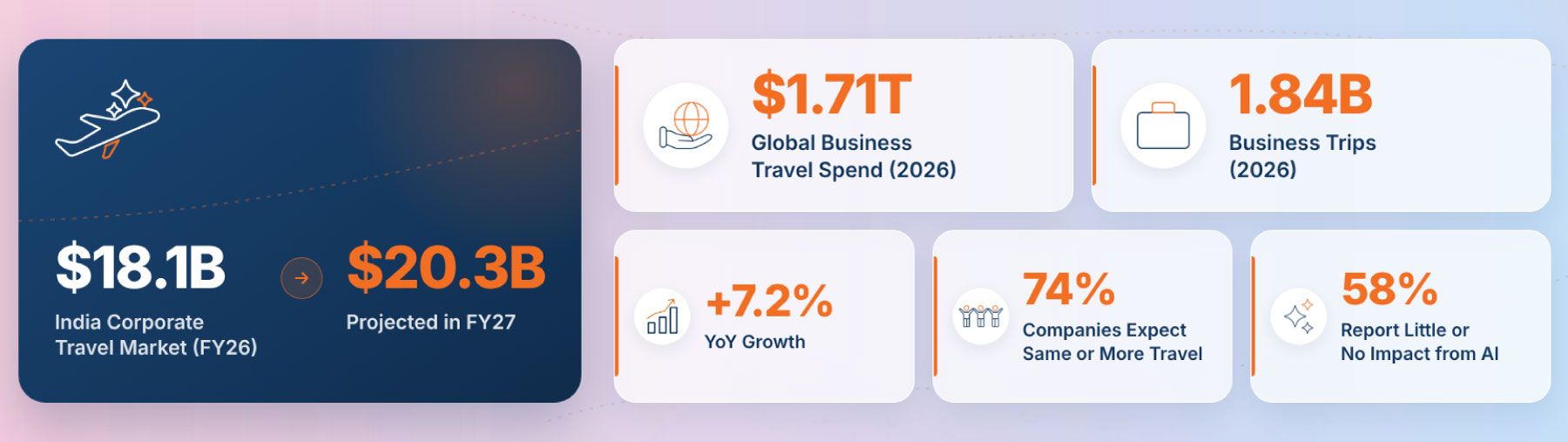
According to VIDEC's India Corporate Travel: Market Sizing & TMC-OTA Benchmarking Study (June 2025), India's corporate travel market was estimated at $18.1 billion for FY26 and is projected to reach $20.3 billion in FY27. The scale of this expenditure makes effective travel and expense governance increasingly important.
A well-designed travel policy should establish:
- Clear eligibility criteria: Define which employees qualify for travel allowances, per diem payments, and expense reimbursements
- Destination-based limits: Account for differences in accommodation, meals, and transportation costs across locations
- Documentation requirements: Specify which expenses require receipts, invoices, or additional approvals
- Approval workflows: Establish approval levels based on trip value, employee grade, and expense category
- Tax and compliance guidelines: Ensure that allowances and reimbursements are classified correctly and supported by appropriate records
Managing these requirements through disconnected spreadsheets, email approvals, and manual expense submissions can make it difficult for finance teams to maintain visibility over travel spending.
An integrated expense management platform can bring travel expense submissions, policy checks, approvals, and reimbursement tracking into a single workflow. This helps finance teams identify policy exceptions, monitor spending patterns and improve accountability without creating unnecessary administrative work for employees.
Final Thoughts
Travel reimbursement and travel allowance serve different purposes, but both play an important role in corporate travel management. While allowances offer employees a predictable budget, reimbursements provide organisations with greater visibility into actual expenditure.
For businesses, the priority should be to establish a policy that balances employee flexibility with financial accountability and tax compliance. With the right processes and expense management technology, organisations can simplify claims, improve spending visibility and make more informed decisions about business travel.
Explore how TripGain's expense management platform helps businesses manage travel expenses, automate reimbursement workflows, and maintain greater control over corporate spending.

Disha Chatterjee
Senior Content MarketerIn this article

Related Blogs