Is MCP Secure? How OAuth 2.1 with PKCE Protects AI-to-Data Connections
The rise of AI agents is changing how software interacts with enterprise systems.
Instead of simply generating responses, modern AI assistants can retrieve information, invoke tools, query databases, and take actions across connected applications. Model Context Protocol (MCP) provides a standardized way for AI applications to connect with these external tools and data sources.
But with greater connectivity comes a critical question:
How secure is an MCP connection when it can access sensitive enterprise data and tools?
The answer depends on the security architecture surrounding the MCP implementation. For authenticated MCP servers, OAuth 2.1 with Proof Key for Code Exchange (PKCE) provides an important layer of protection against authorization-code interception, client impersonation, and unauthorized access.
This is particularly important for MCP deployments involving local applications, desktop AI clients, remote servers, and enterprise systems.
MCP Creates a New Security Boundary
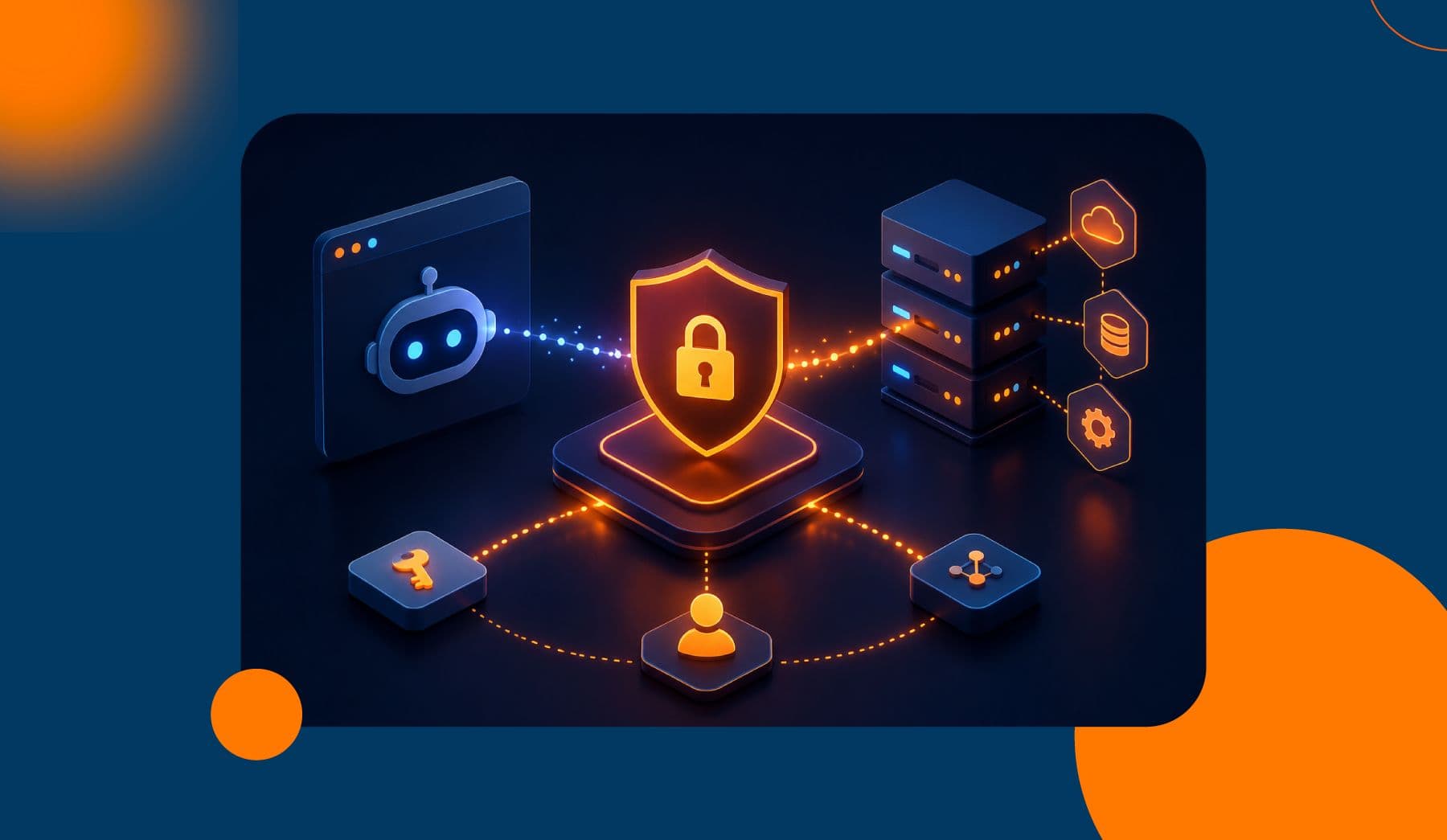
An MCP server acts as a bridge between an AI client and external resources such as APIs, databases, business applications, or enterprise tools.
A typical interaction may look like this: AI Client → MCP Server → Enterprise Application
When the MCP server needs to access a protected service on behalf of a user, authentication and authorization become essential.
This creates a new security boundary. The AI client needs to prove who it is, the user needs to authorize access, and the MCP server needs to ensure that the authorization belongs to the correct session and client.
This is where OAuth 2.1 and PKCE become particularly valuable.
Why OAuth 2.1 Alone Isn't the Whole Story
OAuth allows an application to obtain an access token without requiring the user to share their credentials directly with that application.
However, the authorization code itself becomes a sensitive asset during the login flow.
Consider a simplified flow:
- An AI client initiates authentication
- The user authenticates through the authorization server
- The authorization server returns an authorization code
- The client exchanges that code for an access token
- The MCP server uses the resulting authorization to access the permitted resource
If an attacker can intercept the authorization code before it is exchanged, they may attempt to use it themselves.
This risk is particularly relevant for public clients, desktop applications, local MCP servers, and localhost redirect flows, where traditional client-secret-based authentication is difficult or inappropriate.
That's the problem PKCE is designed to address.
What Is PKCE?
PKCE stands for Proof Key for Code Exchange.
Rather than relying on a static client secret, PKCE creates a temporary cryptographic relationship between the authorization request and the client that initiated it.
The process is straightforward:
- Generate a Code Verifier: The client creates a unique, high-entropy secret for that specific authentication session
- Create a Code Challenge: The client derives a challenge from the verifier and sends that challenge as part of the authorization request
- Receive the Authorization Code: After the user authenticates and grants permission, the authorization server returns an authorization code
- Prove Possession: When exchanging the authorization code for a token, the client must provide the original Code Verifier
The authorization server verifies that the verifier matches the challenge associated with the authorization request.
If it doesn't match, the exchange fails. In other words, stealing the authorization code alone is no longer enough.
How PKCE Strengthens MCP Security
It Protects Localhost Redirects
Many MCP environments can involve locally running components and loopback redirects such as: 'http://127.0.01'
This introduces a potential attack surface. Another process running on the same machine could potentially observe traffic associated with the redirect and attempt to capture the authorization code.
With PKCE, capturing the code does not provide the attacker with everything required to obtain an access token. The attacker would also need the Code Verifier, which remains with the legitimate client session.
Result: Intercepted authorization codes become significantly less useful to an attacker.
It Protects Desktop and Native AI Clients
Desktop AI applications and other native clients cannot safely rely on storing a traditional OAuth client secret.
Why? Because anything embedded within a distributed application can potentially be extracted.
PKCE addresses this limitation by replacing the need for a long-lived client secret with a per-session cryptographic proof. This is particularly useful for AI applications that initiate authentication from a user's desktop environment.
Even if another application attempts to impersonate the legitimate client during the authorization flow, it cannot successfully complete the token exchange without the verifier generated by the original session.
It Removes the Need for Hardcoded Client Secrets in Public Clients
Traditional OAuth architectures often rely on client secrets to authenticate confidential applications.
That model doesn't translate cleanly to every MCP environment. An open-source application, locally installed AI client, or distributed application cannot realistically keep a secret confidential if that secret is shipped to every user.
PKCE changes the equation.
Instead of asking, “Does this application know the permanent secret?", the authorization flow asks, “Does this client possess the cryptographic verifier generated when this authorization request began?”
That makes PKCE particularly appropriate for public clients where a static secret cannot be reliably protected.
It Helps Prevent Authorization-Code Injection
PKCE also helps protect against scenarios where an attacker attempts to inject or substitute an authorization code into an active authentication flow.
The authorization code is bound to the Code Challenge created during the legitimate authorization request. When the token exchange occurs, the server verifies the corresponding Code Verifier.
If an attacker introduces a different authorization code that is not associated with the legitimate session, the verifier won't match. The token exchange fails. This creates an important security property: the authorization code is not useful by itself.
The Security Principle Behind PKCE
The simplest way to understand PKCE is this - the authorization code identifies the transaction, and the Code Verifier proves who initiated it.
Without PKCE, possession of an intercepted authorization code could potentially be enough to continue the OAuth flow. With PKCE, the attacker needs both: Authorization Code + Code Verifier.
The verifier is generated for the specific authentication session and is not exposed through the authorization redirect. This effectively binds the authorization response to the client that initiated the request.
Why This Matters for Enterprise MCP Deployments
For enterprises, MCP security isn't simply about protecting an AI model. It is about protecting the systems the AI can reach.
An MCP server may sit between an AI assistant and sensitive enterprise resources such as:
- Travel and expense platforms
- ERP systems
- Financial data
- HR systems
- Procurement platforms
- Internal APIs
- Business databases
- Operational tools
That means authentication cannot be treated as an afterthought.
A secure MCP architecture should ensure that:
- Identity is verified
- Authorization is explicit
- Sessions are bound to legitimate clients
- Tokens are protected
- Access is limited to the permissions granted
OAuth 2.1 with PKCE addresses an important part of that equation by strengthening the authorization flow itself.
Security Is More Than One Protocol
It is important to make one distinction clear:
PKCE does not make an MCP implementation automatically secure.
It is one component of a broader security architecture.
A production-grade MCP deployment should also consider authorization scopes, token protection, transport security, session management, access controls, logging, monitoring, rate limiting, secret management, and the permissions exposed through individual MCP tools.
The principle should be least privilege - an AI client should receive only the access it needs to perform an authorized task - not unrestricted access to an entire enterprise environment.
The security of an MCP deployment ultimately depends on the complete architecture, not a single protocol.
Building Trust Around AI Connectivity
The promise of MCP is significant: AI systems can move beyond generating information to securely interacting with the applications businesses already use.
But enterprise adoption requires more than functionality.
It requires confidence that an AI connection cannot become an unintended pathway into sensitive systems.
OAuth 2.1 with PKCE helps establish that foundation by binding authorization flows to the client session that initiated them and ensuring that an intercepted authorization code cannot simply be exchanged for access.
For organizations exploring MCP-enabled AI, the right question isn't:
“Can AI connect to our systems?”
It is:
“Can AI connect to our systems with the right identity, the right permissions, and the right security controls?”
That is the standard enterprise MCP implementations need to meet.
And with security designed into the architecture from the beginning, MCP can become more than a connectivity standard - it can become a controlled, auditable bridge between AI, and enterprise systems.

Disha Chatterjee
Senior Content MarketerIn this article
1.MCP Creates a New Security Boundary
2.Why OAuth 2.1 Alone Isn't the Whole Story
3.What Is PKCE?
4.How PKCE Strengthens MCP Security
5.The Security Principle Behind PKCE
6.Why This Matters for Enterprise MCP Deployments
7.Security Is More Than One Protocol
8.Building Trust Around AI Connectivity

Related Blogs