Beyond Bookings: What Indian Companies Reveal About the Real State of Business Travel in 2026
Business travel in India is no longer in recovery mode-it is firmly in a growth phase. But beneath that growth lies a more complex reality, one that most organizations are only beginning to confront.
Last year, we analyzed responses from stakeholders across HR, Finance, IT, leadership, and business travelers to understand how corporate travel is actually managed today. What emerges is not a story of inefficiency alone, but of structural misalignment, where intent, tools, and execution are all present, yet rarely connected.
The real challenge in 2026 is no longer ‘how to book travel’, but how to control and optimize it in real time.
Growth Is Visible. Control Is Not.
At first glance, most organizations appear to have matured. Policies exist. Budgets are defined. Technology is in place.
But maturity, in this case, is uneven.
Take booking behavior as an example. Nearly 46.9% of organizations operate in a hybrid model, where some trips are managed centrally while others are initiated by employees or teams. On its own, that may seem flexible. In practice, it introduces variability into a process that ideally requires consistency.
Because once booking is fragmented, everything that follows - approvals, payments, expense tracking - tends to fragment with it. What emerges is not a broken system, but a distributed one. And distributed systems, while functional, are inherently harder to control.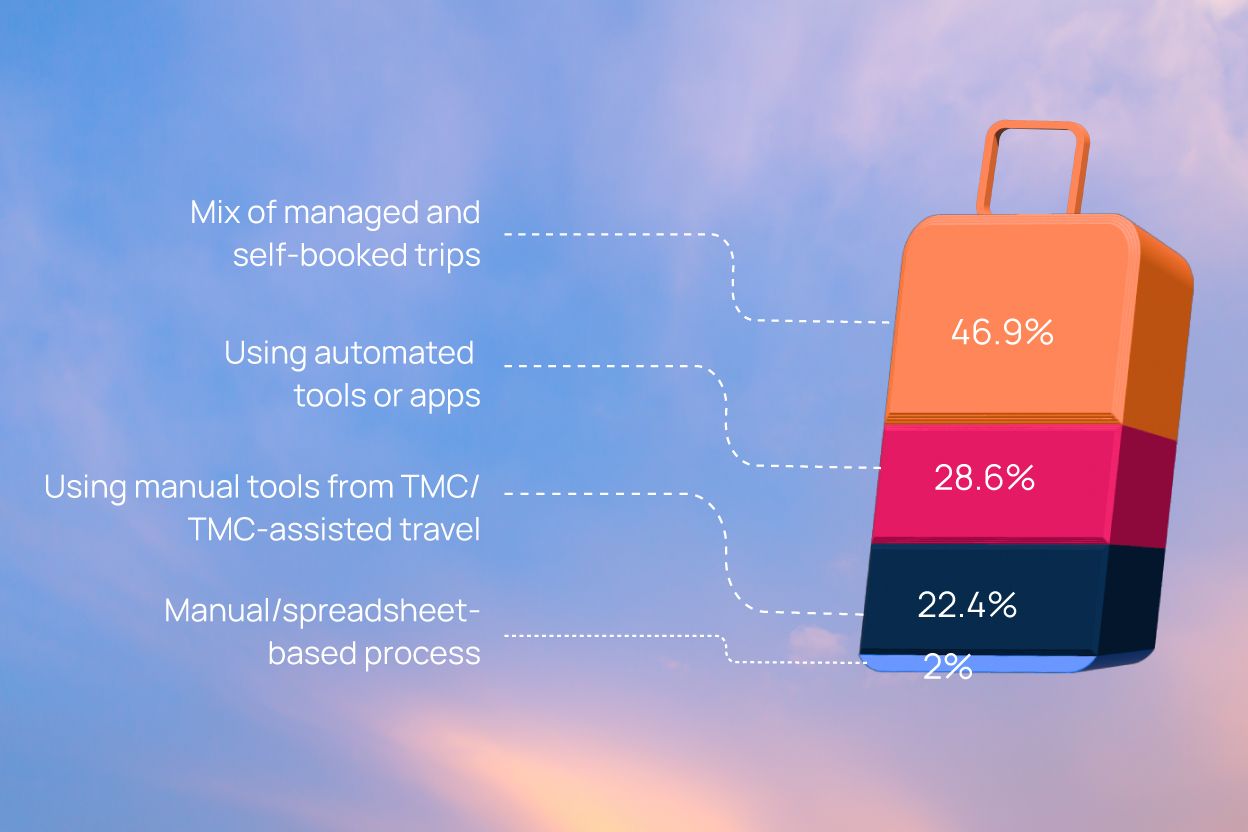
The Hidden Cost of ‘Defined’ Systems
One of the more telling patterns in the research is how often structure is mistaken for control.
A significant share of organizations have formalized their travel policies. Yet, when you look at how those policies are enforced, the picture shifts. Execution still depends heavily on manual approvals, individual oversight, and sequential workflows that were not designed for scale.
This becomes most visible in reimbursement cycles. For a majority of employees, reimbursements take over a week to process. That delay is not just an operational inefficiency, it reflects a system where financial control happens after the transaction, not during it.
Over time, this creates a disconnect between intent and outcome. Policies are designed to guide behavior, but without real-time enforcement, they often end up documenting it instead.
Where Ownership Doesn’t Translate to Control
Travel budgets, in most organizations, are tightly governed. Finance or Procurement typically holds ownership, with clear expectations around cost control and compliance.
But ownership, in this case, does not always translate to influence.
Decisions that shape travel spend - what gets booked, when, and at what price - are often made across departments and teams. This creates a structure where accountability is centralized, but decision-making is distributed.
The implications are subtle but significant. Without visibility at the point of booking, Finance teams are left to manage outcomes rather than shape them. Control becomes retrospective, dependent on reports and reconciliations that arrive after the spend has already occurred.
The Limits of Layered Automation
Over the past few years, many organizations have invested in digitizing their travel processes. Booking tools, expense platforms, and approval systems are increasingly common.
And yet, the experience on the ground suggests that efficiency gains have plateaued.
The reason lies in how technology has been adopted. In most cases, automation has been layered onto existing workflows rather than re-architecting them. As a result, while certain steps may be faster, the overall process remains fragmented.
This is where the expectation gap begins to show. Technology promises seamlessness, but in practice, organizations often end up navigating a combination of digital interfaces and manual dependencies. The friction doesn’t disappear, it simply shifts.
Where the System Actually Feels Broken
What’s particularly striking is that the most visible friction in business travel does not occur at the point of booking.
It surfaces later.
For employees, it appears in the form of delayed reimbursements, unclear processes, or lack of support when plans change. For HR and admin teams, it shows up as coordination overhead that increases with every additional trip. For Finance, it manifests as incomplete visibility and delayed reconciliation.
These are not isolated inefficiencies. They are interconnected outcomes of a system where each stage operates independently. When viewed in isolation, each part functions. But from an end-to-end perspective, the experience becomes inconsistent.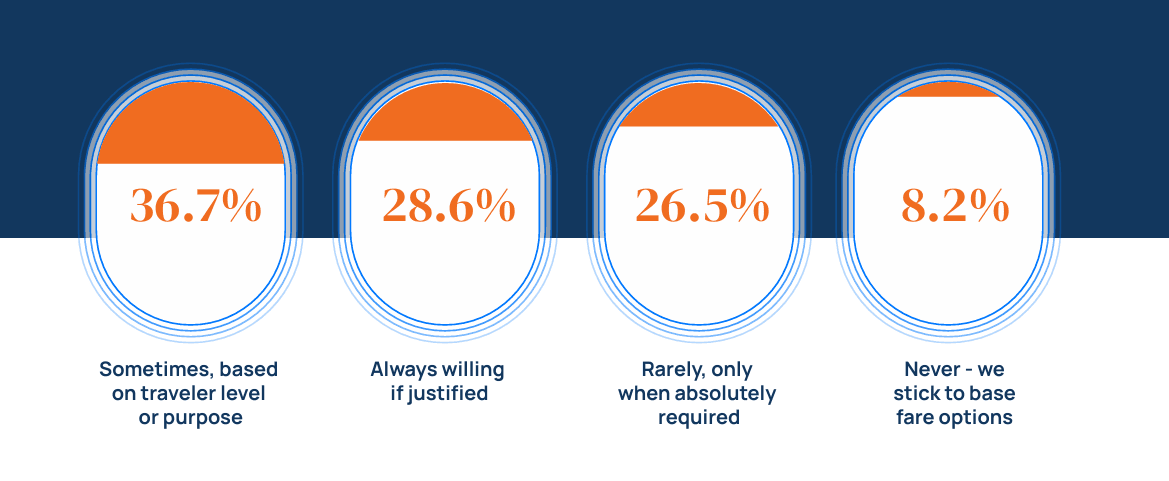
A Subtle Shift in What Organizations Value
As organizations reassess their travel programs, their definition of success is also evolving.
Cost control, while still important, is no longer sufficient on its own. There is a growing emphasis on speed, clarity, and flexibility, particularly in environments where travel decisions need to be made quickly and adjusted just as fast.
This is reflected in how organizations are prioritizing improvements. There is increasing attention on reducing delays, improving visibility into available options, and enabling better decision-making at the point of booking, not after.
It signals a broader shift, from managing travel as an administrative function to treating it as a dynamic, decision-driven process.
The Bigger Picture: A System Problem, Not a Tool Problem
What the State of Business Travel 2026 in India ultimately reveals is not a lack of tools, but a lack of cohesion.
Across organizations, booking, approvals, payments, and expenses continue to operate as separate layers. Each is optimized individually but rarely aligned as part of a single workflow.
As travel volumes increase, this lack of alignment becomes more pronounced. Not necessarily as large as disruptions, but as consistent inefficiencies that affect speed, visibility, and control.
Organizations that continue to approach travel in fragments will find it increasingly difficult to scale. Those that bring these elements together, connecting decisions, policies, and data in real time, will be better positioned to manage both growth and complexity.
Why This Report Matters Now
For leaders in Finance, HR, and Operations, this is less about identifying problems and more about recognizing patterns.
Because many of these challenges don’t appear as exceptions. They appear as ‘how things work’.
The value of this research lies in making those patterns visible, so organizations can assess whether their current systems are enabling control or simply managing its absence.
The Next Step
The full State of Business Travel 2026 report goes deeper into how these patterns play out across roles, where the most significant gaps exist, and what distinguishes organizations that are able to manage travel proactively from those that remain reactive.
If you are evaluating your current approach or questioning whether your systems can scale with your growth, the full report offers a more complete view.
Download the full ‘State of Business Travel in India 2026’ report to benchmark your program and uncover where the real opportunities lie.

Disha Chatterjee
Senior Content MarketerIn this article
1.Growth Is Visible. Control Is Not.
2.The Hidden Cost of ‘Defined’ Systems
3.Where Ownership Doesn’t Translate to Control
4.The Limits of Layered Automation
5.Where the System Actually Feels Broken
6.A Subtle Shift in What Organizations Value
7.The Bigger Picture: A System Problem, Not a Tool Problem
8.Why This Report Matters Now
9.The Next Step

Related Blogs