
CFO’s Strategic Guide to Spend Intelligence with TG Spend Copilot
The CFO’s Reality in 2026: Data Is Not the Problem. Latency Is.
In the current global economy, the mandate for finance leaders has shifted from simply recording history to actively shaping the future.
With global business travel spend projected to reach $1.62 trillion by 2026, according to research from Quantumrun’s Business Travel Statistics & Forecasts, and 35% of CFOs citing poor cost management as a top internal threat, the need for financial precision and real-time spend insight is at an all-time high.
Finance teams today do not suffer from a lack of data. They suffer from delay.
Every system - ERP, travel booking platforms, expense tools, corporate cards, procurement software - captures transactions in real time. Yet the insight cycle remains slow. Finance pulls reports weekly or monthly, consolidates spreadsheets, reconciles inconsistencies, builds presentations, and delivers findings long after the financial behavior has already occurred.
This delay creates a structural disadvantage.
By the time a CFO sees that international airfare spend is 22% above trend, those tickets are already flown.
By the time policy violations spike in one department, the quarter has closed.
By the time vendor concentration risk is identified, the negotiation window has passed.
At the same time, research from Deloitte’s 2025 Corporate Travel Survey shows that a majority of travel managers now see rising costs and sustainability commitments as key factors shaping corporate travel strategy, signaling closer executive scrutiny on travel ROI, cost containment, and environmental impact.
In other words:
Spend is increasing.
Oversight expectations are increasing.
Tolerance for reporting delay is decreasing.
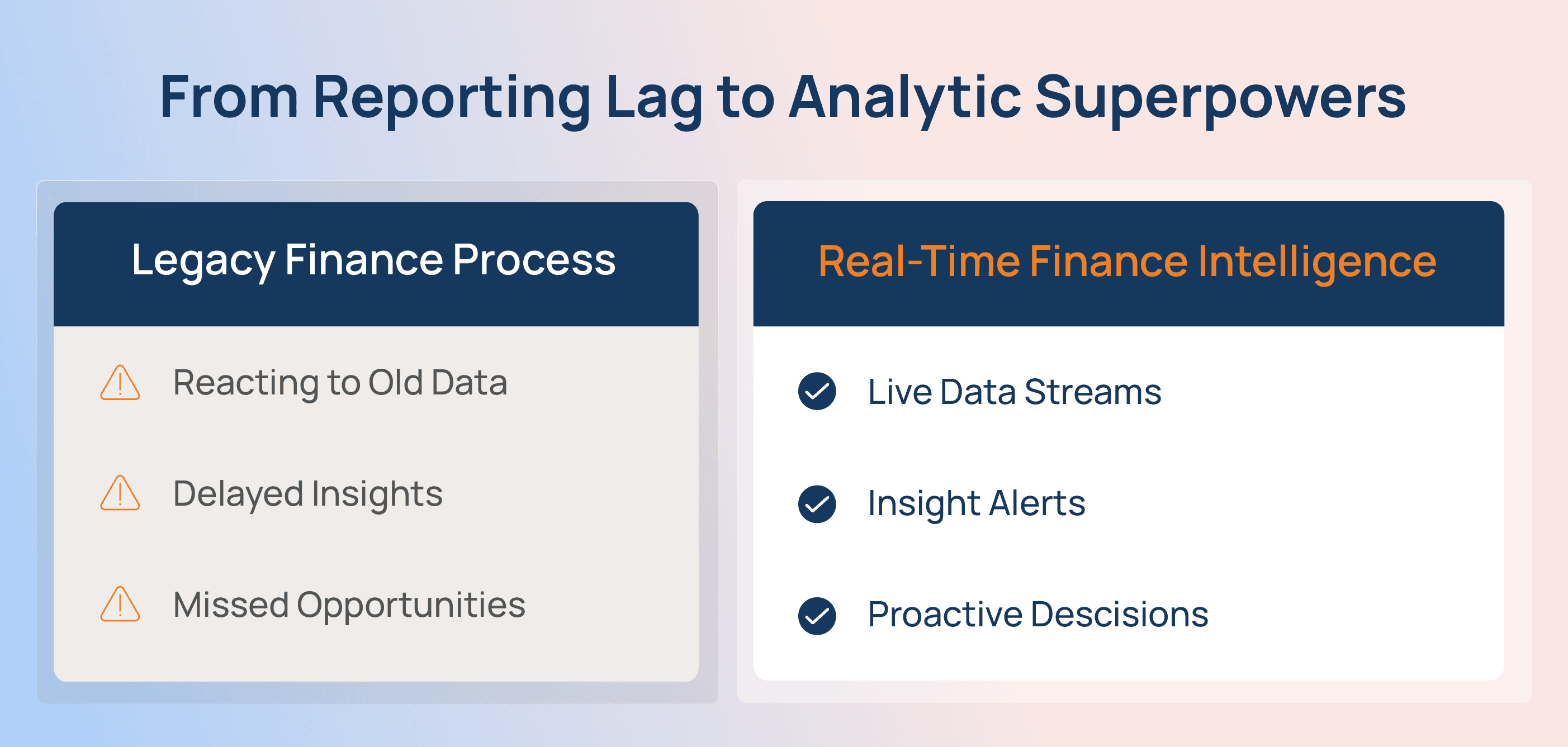 This is the environment in which TG Spend Copilot operates. It does not replace systems of record. It removes insight latency. And in doing so, it provides what modern finance leaders require - Analytic Superpowers.
Part 1: The New Paradigm, Why Conversational AI Is the Need of the Hour
The shift toward Natural Language Processing (NLP) in finance is not a trend. It is a response to structural inefficiency.
Finance has long operated on the question, “What happened?”
Modern finance must answer:
“Why did it happen?”
“What will happen next?”
“How do we influence the outcome?”
The Trend: Breaking the Data Silos
According to Gartner, piecemeal investments in finance systems have created fragmented data silos that delay decision-making.
Conversational AI breaks these silos.
Instead of navigating dashboards, exporting CSV files, or writing SQL queries, leaders ask questions in plain English, “At our current run rate, will we exceed our annual travel budget?”
Within seconds, TG Spend Copilot reasons across structured financial datasets and delivers forward-looking insight.
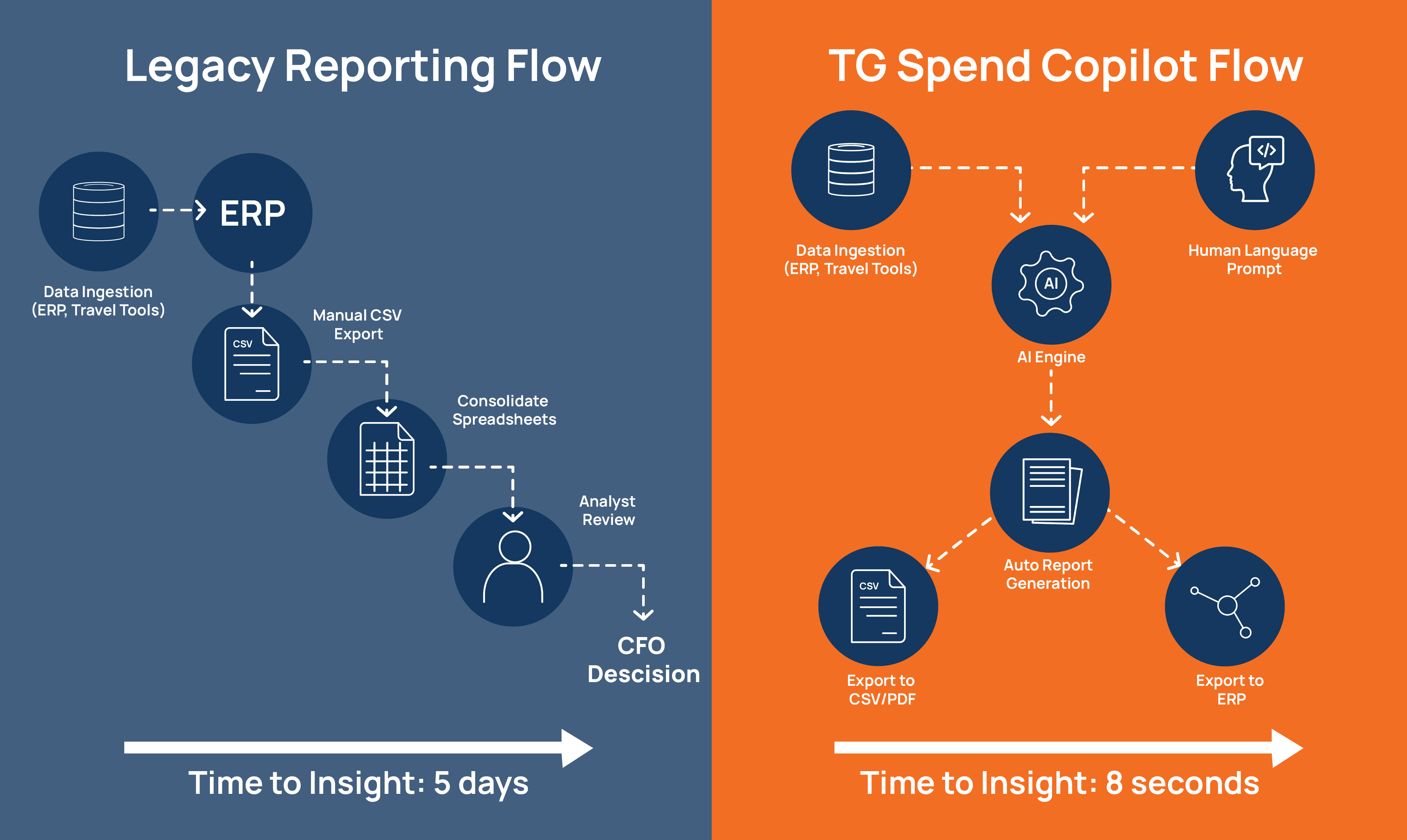
The Efficiency Gap: From Dashboards to Reasoning Engines
Traditional systems require rigid SQL queries or static dashboards. They retrieve rows.
TG Spend Copilot uses a Multi-LLM architecture (supporting GPT-4o, Claude 3.5, and Gemini 1.5) to function as a reasoning engine.
It does not just fetch numbers. It:
- Interprets intent
- Segments relevant datasets
- Performs statistical modeling
- Identifies patterns
- Projects forward scenarios
- Surfaces financial implications
This is the difference between reporting and reasoning.
Research from McKinsey & Company indicates that AI-driven finance teams spend 20-30% less time on data crunching, freeing capacity for strategic decisions.
The Security Standard: Intelligence Without Exposure
In an era of escalating data breaches, financial intelligence must not compromise data sovereignty.
TG Spend Copilot employs a 6-layer security model including:
- SQL safety enforcement
- Tenant-level data isolation
- Zero-exposure architecture
- Encrypted query processing
- Role-based access controls
- Secure infrastructure containment
Financial data never leaves your secure environment. Speed does not come at the cost of security.
Part 2: The Six Pillars of AI-Driven Spend Management
To deliver true analytic superpowers, TG Spend Copilot organizes 13+ capabilities into six strategic domains. Each addresses a structural weakness in modern finance operations.
Section 1: Real-Time Budget vs. Actuals
From Month-End Surprises to Continuous Financial Control
In most organizations, travel budgets are approved annually, reviewed quarterly, and reconciled monthly. This cadence no longer matches economic volatility.
Airfare fluctuates daily. International routes can swing 15-25% within weeks. Hotel ADRs vary by season and city-level demand. Business expansion creates unplanned travel bursts. Yet finance still reviews variance after the month closes.
By the time sales exceeds travel allocation by 18%, intervention becomes restrictive rather than preventive.
Traditional reporting answers “What happened?”
It rarely answers:
“When did it start?”
“Is it accelerating?”
“At this pace, what will quarter close at?”
“What intervention prevents breach?”
When a CFO asks TG Spend Copilot “At the current run rate, will we exceed our annual travel budget?” , it:
- Aggregates YTD spend
- Adjusts for seasonality
- Projects forward variance
- Identifies accelerating cost centers
- Visualizes breach risk
Instead of reacting to overspend, finance steers around it.

Section 2: Vendor Spend & Negotiation Insights
Turning Travel Data into Procurement Leverage
CFOs often leave money on the table due to insufficient negotiation intelligence. According to the Global Business Travel Association forecast, global hotel average daily rates (ADR) are projected to rise 1.8% in 2026, even as overall travel pricing stabilizes. In this environment, contract leakage, where negotiated rates are not consistently applied, can represent up to 4% of total travel spend, quietly eroding budgets despite seemingly moderate price growth.
Consider this:
28% of bookings occur outside preferred carriers.
14% are booked within three days of departure, inflating fares by 40%.
Two departments drive 60% of non-preferred bookings.
The contract is not failing. Behavior is.
TG Spend Copilot surfaces, “Airline A accounts for 42% of international spend. Negotiated rates applied in 68% of eligible bookings. Estimated annual leakage: $18,400.”
Negotiation shifts from anecdotal to analytical. Optimization replaces suppression. 
Chapter 3: Policy Leakage & Anomaly Detection
From Post-Facto Audits to Continuous Risk Intelligence
Policy compliance is the silent killer of T&E budgets.
While many companies have established booking tools, Deloitte’s study reveals that 3 in 10 business travelers still never book through managed corporate channels. This creates a massive 'visibility gap' for the CFO. TG Spend Copilot bridges this gap by offering a conversational interface that travelers actually want to use, capturing 100% of data while ensuring compliance.
Small deviations compound:
Late bookings
Missing documentation
Approval delays
Threshold splitting
Airfare booked within three days can cost 40-60% more than tickets booked two weeks in advance.
TG Spend Copilot identifies:
- Booking window distributions
- Statistically significant fare outliers
- Expense anomalies
- Duplicate patterns
- Approval delay impact
Instead of reporting violations, it quantifies financial impact and compliance becomes measurable margin protection. 
Section 4: AI-Driven Spend Forecasting
From Static Budgets to Living Financial Models
Forecasting in volatile environments cannot rely on historical averages.
Boards demand predictability, not ‘best guesses’.
TG Spend Copilot enables:
“What is forecasted travel spend next quarter?”
“What is projected savings from enforcing a 14-day booking rule?”
It integrates:
- Real-time spend ingestion
- Departmental segmentation
- Regression-based projections
- Scenario modeling
- Forecasting becomes interactive
Finance moves from asking, “Where will we land?” to asking, “How do we influence where we land?” 
Section 5: Deep-Dive Cost Center Analysis
Turning Spend Visibility into Accountability
Aggregate spend masks inefficiency.
If Engineering spends $13,000 per traveler and Sales spends $28,000, the average hides divergence. Deloitte reports that 1 in 5 large companies are cutting travel budgets in 2025-26. The challenge is cutting intelligently.
TG Spend Copilot ranks departments by:
- Spend per traveler
- Policy compliance
- Booking discipline
- Savings capture
- Composite Health Score
Finance distinguishes justified high spend from avoidable inefficiency. Transparency drives self-regulation. 
Section 6: ESG & Carbon Footprint Tracking
Integrating Sustainability into Financial Governance
Sustainability is no longer optional within corporate travel programs. According to the Global Business Travel Association global benchmark on sustainable business travel, corporations remain committed to climate targets but continue to struggle in high-impact areas such as emissions measurement and reduction execution.
The gap is not intent. It is integration.
In most organizations, carbon reporting operates separately from financial reporting. Yet travel emissions are directly tied to financial decisions, route mix, cabin class, booking behavior, and supplier selection.
When a CFO asks, “What is our carbon footprint this quarter?”, the answer must connect cost and carbon, not treat them as parallel metrics.
TG Spend Copilot embeds emissions intelligence directly into spend analytics, aligning:
- Cost per trip
- Carbon per trip
This dual visibility enables financially sound decisions that also advance sustainability goals, turning ESG from a reporting obligation into an operational lever.
Part 3: Turning Challenges into Strategy, The Prompt Playbook
Finance teams are moving from data retrieval to strategic action.
For Efficiency: “Which approvers have the longest average approval time? Recommend an auto-approval threshold.”
For Cash Flow: “Summarize open AR by aging bucket and top 10 overdue customers.”
For Growth: “What can I cut without slowing growth? Show ROI of top 10 most expensive trips.”
This is not reporting. It is conversational decision support.
Conclusion: Measurable ROI
Adopting conversational analytics reduces time-to-insight by up to 90%.
Research compiled on automated invoice and expense systems indicates a median 150% ROI in the first year (ResearchGate).
But the deeper impact is strategic. Finance transitions from reactive reporting to proactive decision-making.
TG Spend Copilot does not replace finance judgment. It amplifies it.
In a world where CFO performance is defined by speed, clarity, and foresight, removing insight latency is not incremental. It is structural.
Ready to operate with real-time financial intelligence?
Get started in under a day.
No new infrastructure.
No data migration.
No complex training.

Disha Chatterjee
Senior Content MarketerIn this article
1.The CFO’s Reality in 2026: Data Is Not the Problem. Latency Is.
2.Part 1: The New Paradigm, Why Conversational AI Is the Need of the Hour
3.The Trend: Breaking the Data Silos
4.The Efficiency Gap: From Dashboards to Reasoning Engines
5.The Security Standard: Intelligence Without Exposure
6.Part 2: The Six Pillars of AI-Driven Spend Management
7.Section 1: Real-Time Budget vs. Actuals
8.Section 2: Vendor Spend & Negotiation Insights
9.Section 3: Policy Leakage & Anomaly Detection
10.Section 4: AI-Driven Spend Forecasting
11.Section 5: Deep-Dive Cost Center Analysis
12.Section 6: ESG & Carbon Footprint Tracking
13.Part 3: Turning Challenges into Strategy, The Prompt Playbook
14.Conclusion: Measurable ROI