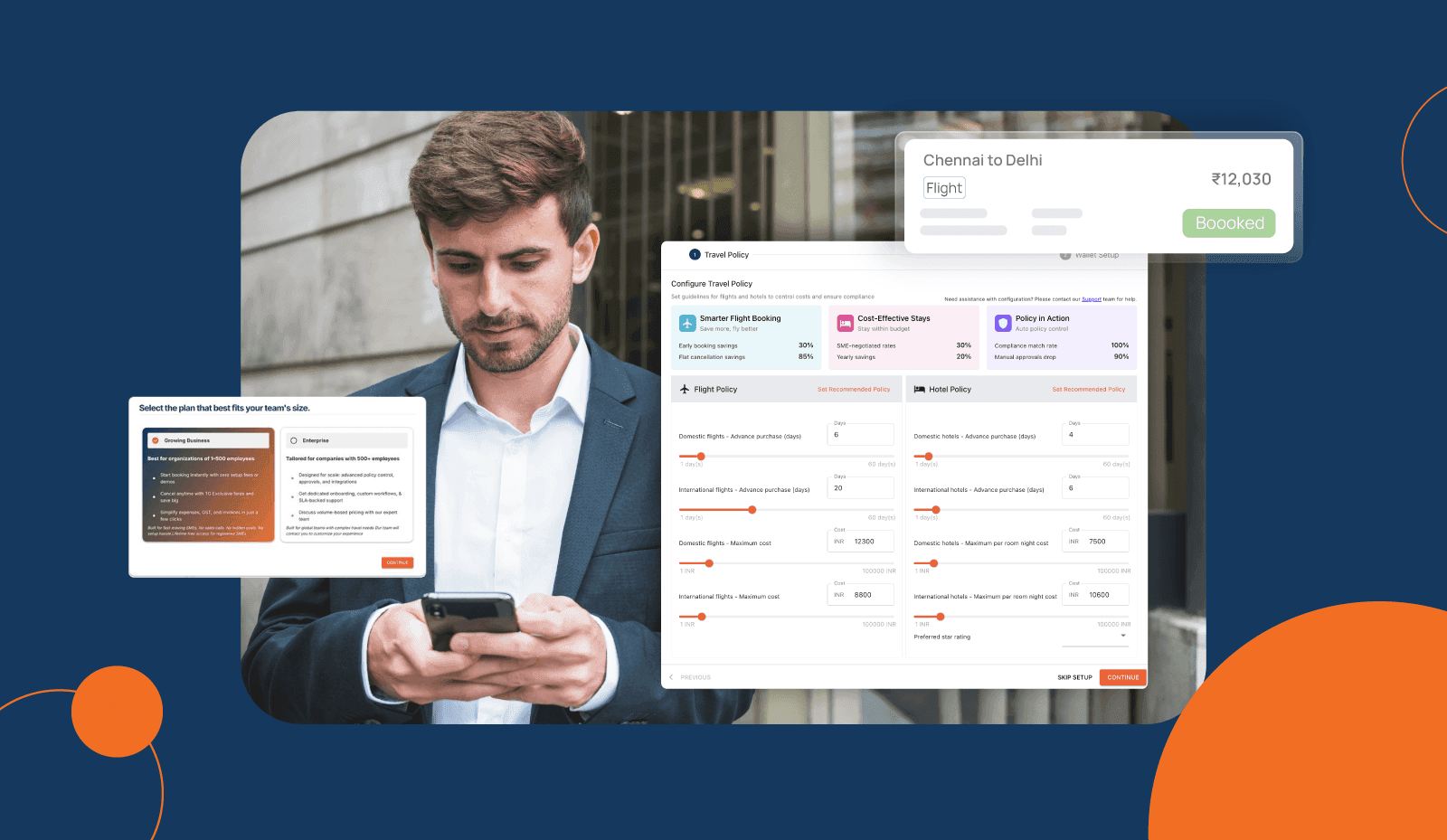
How to Manage 10 Team Bookings Without 10 Calls: The New Way to Book Smarter

TL;DR
Managing 10 team bookings doesn't have to consume your entire week. It doesn't have to mean 10 approval chains, fighting out-of-policy bookings, or playing email tag until 9pm.
The tech exists today. Centralized platforms cut booking time by 70%, improve compliance to 94%, save 30 hours per week, and deliver 15% cost savings.
When you're spending 4.2 hours per booking manually and the right tool cuts that to 45 minutes, when 81% of companies are bleeding money on hotel leakage, when 20% of companies expect budget cuts despite rising travel - you literally can't keep doing this the old way.
The travel admins who switched to modern platforms stopped answering the same booking questions months ago. They stopped losing weekends to approvals. They stopped explaining out-of-policy charges to finance.
They're managing 10 bookings in the time it used to take to manage 2.
Maybe it's your turn.
Introduction
Okay, real talk. Your CMO just announced the annual user conference in Vegas. Ten people. Different cities. Different budgets. All need flights, hotels, ground transport. Timeline? 48 hours. Your Slack is already blowing up.
"Can I fly premium?"
"What hotel are we staying at?"
"Wait, I'll just book myself and reimburse it."
You've got 10 email chains, 5 different booking sites open, 3 spreadsheets going, and an expense approval process that feels longer than the actual trip.
If this is giving you flashbacks, you're not alone.
Here's the thing: the average business trip takes about 3 hours to book. Multiply that by 10 travelers? You're looking at nearly two weeks of pure coordination chaos. And the kicker? You're spending 4.2 hours booking each trip manually when automation could cut that to 45 minutes.
Let's talk about how the smartest travel admins stopped losing their minds over group bookings.
The Actual Cost of "Just Making a Few Calls"
Let's be honest about what manual group booking is really costing you.
U.S. business travel hit $121.9 billion in 2023 and represents almost one-third of all tourism spending. It's literally your company's second-biggest expense after payroll, we're talking up to 10% of your entire budget.
And here's where it gets wild: 73% of travel managers expect bigger budgets in 2025. Sounds great, right? Wrong. Because 20% of large companies are actually cutting travel spend despite rising demand.
Translation: you're managing more trips with tighter budgets.
Here's what that actually means for you:
Your time is being stolen. Coordinating 10 bookings manually isn't just booking, it's babysitting email threads, chasing approvals, fielding preference requests, and answering "is this policy-compliant?" on repeat. Every single booking is a mini-project.
Money is leaking everywhere. Get this: 67% of travel managers say air travel leakage stayed the same or got worse, and hotel leakage? 81% people are booking outside your systems, and you're getting absolutely destroyed on rates. The typical company loses 20% to out-of-policy spending. That adds up FAST.
Approvals are in purgatory. 57% of travel managers struggle with the booking experience, 55% can't handle disruptions well, and 50% say expense reports are a nightmare. When everything's manual, approvals get stuck, prices spike, and people get frustrated.
Errors are killing you. Double bookings. Wrong dates. Missed cancellation windows. Manual entry means mistakes, and mistakes cost real money.
Rates keep climbing. Average U.S. business airfare went from $668 in 2023 to $701 in 2024 - that's a 2% jump. Hotels? From $158 to $162 per night. When you're managing 10 travelers, that cost creep is no joke.
When 53% of travel buyers say rising costs are their biggest problem and big companies are tightening approval processes even as travel increases, you literally can't afford to keep doing this the old way.
Why 10 Bookings ≠ 1 Booking × 10
Here's what most people don't get: group bookings aren't linear. They're exponentially more complex.
Think about what you're actually juggling:
- Remote workers in different cities (there are 36 million remote workers in the U.S. btw)
- Different approval tiers depending on seniority
- Individual preferences - airlines, seats, hotels, dietary stuff, accessibility needs
- Different managers for different team members
- Coordinating arrivals so everyone actually shows up around the same time
- Post-trip expenses with 10 different receipt piles
Every layer multiplies the complexity. Add manual coordination? Nightmare fuel.
The companies winning at this aren't working harder. They're working smarter.
The 5 Things That Actually Work
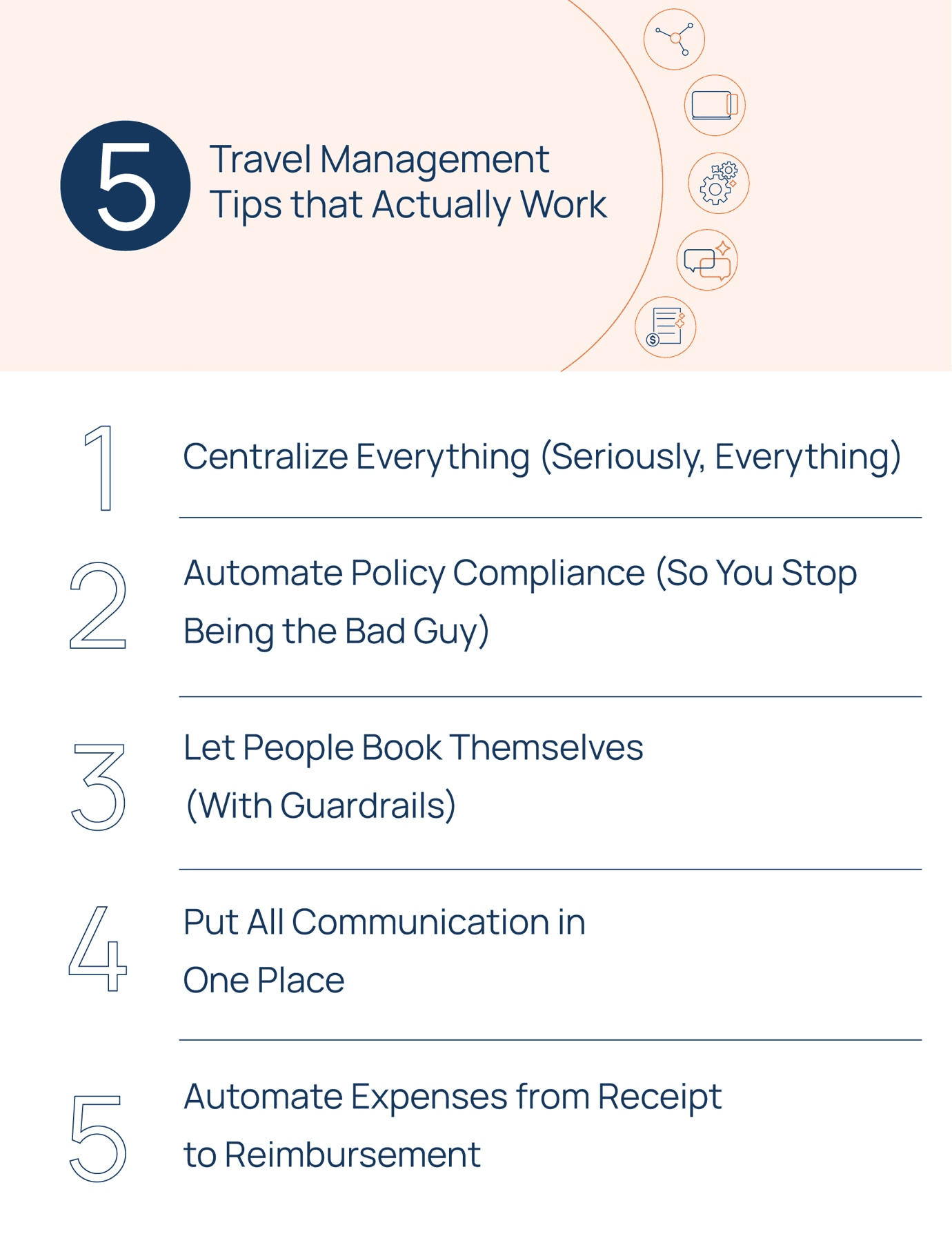
1. Centralize Everything (Seriously, Everything)
Stop juggling email threads, Slack DMs, random booking sites, and status spreadsheets. Just stop.
Companies using centralized platforms save up to 15% on travel costs through better negotiating power. But honestly? The real win is getting your sanity back.
One platform means:
- All 10 bookings visible in one dashboard
- Real-time approval status
- Auto-enforcement of policy rules
- Coordinated logistics without the back-and-forth
- Access from anywhere, any device
(phone or laptop)
This shift is happening whether you're ready or not.
2. Automate Policy Compliance (So You Stop Being the Bad Guy)
When policy is built into your booking system - premium cabin needs exec approval, hotel caps by tier, etc. - you're not the gatekeeper anymore. The system just shows compliant options. If someone needs an exception, it auto-routes to the right person with full context.
SAP Concur [DC1] found that policy-compliant expense reports increased by 65% and 32% more employees followed policy after automation. That's not just compliance - that's changing behavior.
For your 10-person booking:
- Everyone sees only compliant options
- Budget issues flag automatically
- No surprise out-of-policy charges later
- Finance gets clean data
3. Let People Book Themselves (With Guardrails)
The best travel admins stopped trying to do everything. They let employees book within rules.
Platforms like TripGain save travel managers 30 hours per week by enabling self-service.
But, and this is key, self-service without rules is chaos.
Smart platforms let you:
- Set budget caps and preferred vendors
- Require approval only for exceptions
- Auto-route weird requests to the right person
- Track everything centrally
When employees can book within guardrails, they handle the routine 80%, and you only touch the 20% that needs actual judgment.
4. Put All Communication in One Place
Those 47 Slack messages about Vegas logistics? Done.
Group travel platforms let you create an event, invite everyone, share the itinerary, and manage all comms in one app. Everyone sees the same info. Issues get flagged instantly. People can self-service common questions.
5. Automate Expenses from Receipt to Reimbursement
This is where most companies fumble. They nail the booking but lose control on expense management.
Modern platforms capture booking details automatically and sync them to expense reports. Processing time drops from 12.5 days to 2.8 days.
OCR scans electronic receipts instantly. Duplicate detection catches errors. Finance gets real-time visibility. Employees get reimbursed faster. Everyone wins.
What This Actually Looks Like In Real Life
Your Vegas conference with 10 people:
Day 1: Create group booking event. System pulls attendees from HR. Policy rules are already configured by level.
Day 2: Everyone gets booking invites. System shows compliant flights and hotels from preferred vendors. Smart algorithms suggest arrivals within a 2-hour window. Ground transport auto-suggested.
Day 3: Approvals auto-route. Exceptions flag to the right people. Your VP approves 3 higher-tier bookings in 10 minutes.
Day 4: Everything's confirmed. Everyone gets itineraries with all details. One comm channel keeps everyone updated.
During trip: Real-time disruption alerts. Flight delays? Everyone knows. People scan receipts on their phones, expenses auto-populate.
After trip: Complete expense reports with receipts ready for finance in 2 days instead of 2 weeks.
Your actual time invested: 2-3 hours instead of 30+.
The Numbers That Make This a No-Brainer
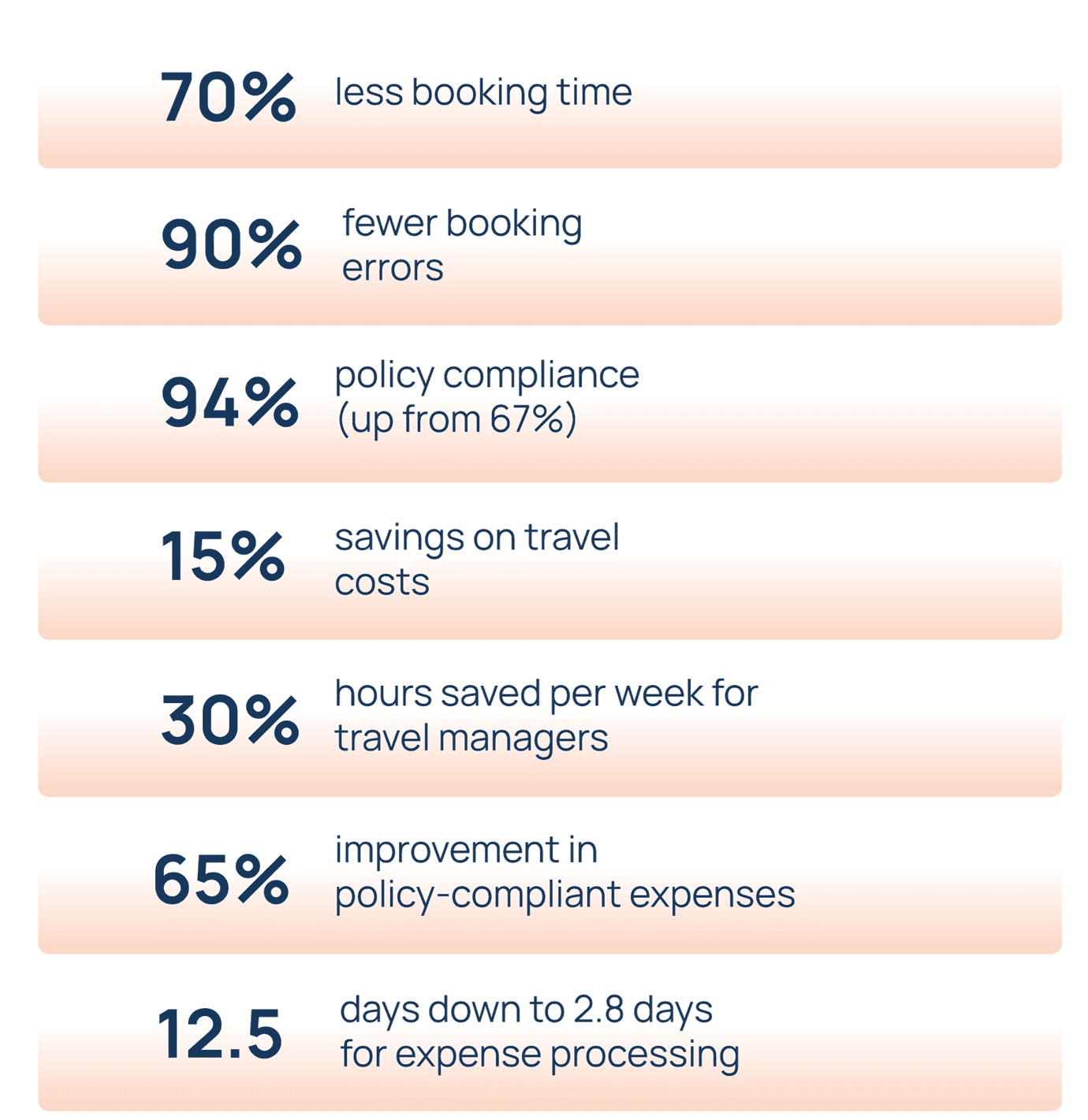
According to Deloitte, GBTA, and Amex GBT:
- 70% less booking time
- 90% fewer booking errors
- 94% policy compliance (up from 67%)
- 15% savings on travel costs
- 30 hours saved per week for travel managers
- 65% improvement in policy-compliant expenses
- 12.5 days down to 2.8 days for expense processing
When the average trip costs $1,600-$1,800 per person and you're managing dozens of trips quarterly, this adds up to six figures annually.
Plus, 64% of travel decision-makers say increased travel budgets directly drive company revenue. This isn't just about saving money - it's about enabling growth.
What to Look for in a Platform
Not all travel software is created equal. Here's what separates the good from the garbage:
- Policy automation that's actually flexible. Rules by level, department, destination, trip type. Automatic enforcement with clear exception workflows.
- Real self-service. Employees book independently within guardrails. You keep visibility and control through dashboards.
- Actual group coordination tools. Create events, invite people, track bookings and communicate - all in one place.
- Real-time visibility. See approval status, booking progress, issues at a glance.
- Integrated expense management. Bookings auto-flow to expense reports. OCR for receipts. Duplicate detection. Automated workflows.
- 24/7 support. Because flight delays don't care that it's 2am.
- Data analytics that matter. Track spending, compliance, vendor performance, ROI.
- Mobile-first. Most booking and expensing happens on phones now.
TripGain: For People Who Are Done With the Old Way
This is where TripGain fits in.
TripGain is an AI-powered travel and expense platform built specifically for business travelers and corporate teams who are tired of the manual coordination nightmare.
You get intelligent policy-based recommendations, one-click group booking, and seamless expense management in one place. The platform auto-enforces policy so out-of-policy bookings don't happen in the first place. OCR-powered receipt capture for instant expense submission. Real-time spending visibility. Integrations with your HR systems, corporate cards, and accounting software.
The whole point is that you shouldn't be spending 30+ hours coordinating 10 bookings. You should be a strategic partner who enables travel, ensures compliance, and controls costs - without the chaos.
Contact us to get a customized demo.

Godi Yeshaswi
Senior Product MarketerIn this article
1.Introduction
2.The Actual Cost of "Just Making a Few Calls"
3.Why 10 Bookings ≠ 1 Booking × 10
4.The 5 Things That Actually Work
5.What This Actually Looks Like In Real Life
6.What to Look for in a Platform
7.TripGain: For People Who Are Done With the Old Way

Related Blogs